




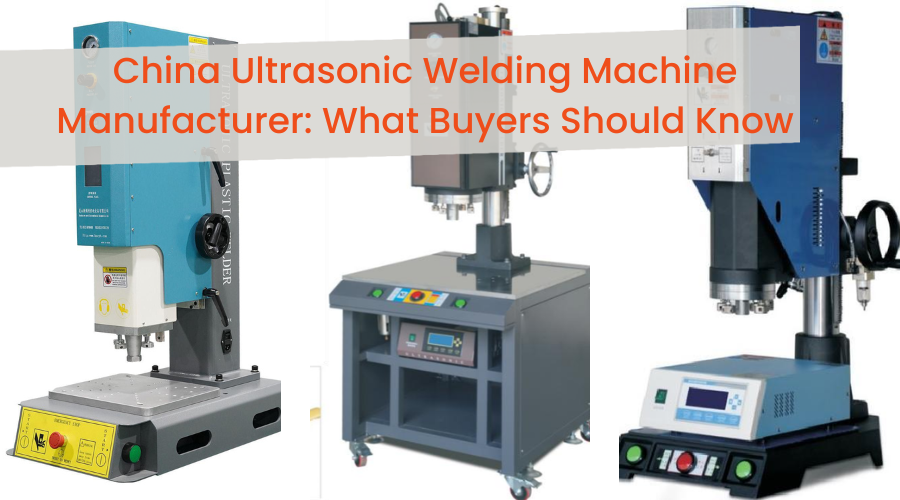
For years, buying industrial machinery from China felt like a gamble. You heard the stories. The machines that arrived non-functional on arrival. The suppliers who vanished after the wire transfer. The “CE” certification that turned out to be a sticker. That era is fading. Fast.
Today, China’s ultrasonic welding sector is undergoing a quiet revolution. You will see CNC machining centers that rival anything in Germany. You will see engineers who cut their teeth at Branson and Telsonic. And you will see a generation of manufacturers who understand that price alone no longer wins contracts but consistency does. Consider the numbers. China now accounts for over 60% of the global ultrasonic welding equipment market. That is not just volume. That is a supply chain so deeply integrated that a single industrial park in Jiangsu can produce a complete welder: from piezoelectric ceramics to the finished chassis all under one roof. No cross-border shipping delays. Just efficiency.
The result? Industrial buyers are paying 30% to 50% less for comparable specifications than they would for European or American brands.
But keep in mind not every Chinese manufacturer belongs in that top tier. In fact, many do not. The market splits roughly into two camps. On one side: world-class innovators building servo-driven metal welders for the EV battery boom. On the other: assemblers who slap together off-the-shelf components and sell on price alone. The difference is not always visible from a website.
So this blog exists for one reason. To help you separate the two. To give you the questions that matter. To show you where to look, what to verify, and how to structure a deal that protects your production line and not just your budget. Because when you source right, China is not a compromise. It is a competitive advantage.
You already know the headline: lower price. But let us dig beneath that surface.
First, vertical integration. Top-tier Chinese manufacturers do not just assemble. They make. They formulate their own piezoelectric ceramics the heart of the transducer. They machine their own core components like horns and boosters in-house. They wind their own coils. When every major component comes from the same factory floor, there are no supplier markups. No logistics delays waiting on Italian crystals or German aluminum. Just control.
Second is the scale. The domestic market in China is enormous. Think automotive interiors. Think medical disposables. Think the EV battery sector, which is consuming ultrasonic metal welders faster than any other region on earth. Manufacturers here are building thousands of units per year, not hundreds. That volume drives down unit cost without necessarily sacrificing quality provided you choose the right supplier.
Third, speed. Lead times tell a story. A custom automation line from a European manufacturer might take six to eight months. A comparable system from a capable Chinese supplier? Often sixty days. Sometimes less. For standard bench-top welders, you are looking at seven to fifteen days. That matters when your production line is down.
Before you contact a ultrasonic welding machine exporter, you need to have clarity on getting a machine that actually matches your demands. Ultrasonic welding is not one technology but is divided into four categories Each offer a compatible solution that matches with specific engineering demands and supplier landscape.
These are the workhorses for repair work, spot welding, and wire harness assembly. The technology is relatively mature. The barriers to entry are low. Consequently, the market is flooded with cheap, unreliable options. Here is what separates the good from the bad: generator stability. A quality handheld unit will maintain consistent amplitude even as the tool heats up during extended use. Cheap units drift. They lose power. They produce inconsistent welds.
Chinese suppliers in Guangdong excel at high-volume production of handheld units. Look for those who publish detailed specifications on amplitude stability and offer interchangeable cartridges for different applications.
This is the standard configuration for plastic welding. Think automotive interior components. Think medical device assemblies. Think consumer electronics housings.
The critical distinction here is control architecture. Older analog machines rely on simple timers and basic pneumatic controls. Modern digital machines offer programmable depth stops, energy modes, and real-time monitoring.
For standard plastic welding, the gap between Chinese and Western brands has narrowed significantly. The best Chinese manufacturers now offer touchscreen interfaces, recipe storage, and data export capabilities that rival anything from Europe or Japan.
This category demands your closest attention. Metal welding is fundamentally different from plastic welding. The tolerances are tighter. The consequences of failure are higher. A poor weld in a battery tab can mean thermal runaway. A weak harness connection can mean a recall.
The EV revolution has driven massive investment in this space. Some Chinese manufacturers have risen to the challenge. They now produce servo-controlled metal welders with real-time monitoring, force detection, and full traceability.
But many have not. You need a high frequency welding machine manufacturer with proven experience in metal welding, not just a plastic welder repurposed for metal applications.
For production lines, the machine is only part of the equation. You need integration. Conveyors. Vision systems. Part handling. Chinese suppliers in the Yangtze River Delta; particularly around Shanghai and Suzhou have developed deep expertise in custom automation. They are building complete systems for Tier 1 automotive suppliers and major electronics manufacturers.
Let us talk about what is actually inside the housing of this gadget. Because here is the truth: two machines can look identical on the outside but their operating performance differs a lot.
Frequency determines what the machine can weld.
20kHz systems are the generalists. They handle most plastic applications and high-power metal welding. They deliver deeper penetration and are suited for larger parts.
35kHz and 40kHz systems are the precision instruments. They deliver finer control, less part marking, and are ideal for small components, medical devices, and delicate assemblies. The trade-off is lower power output.
15kHz systems are the heavy lifters. They deliver maximum amplitude for large-sized parts like automotive bumpers or thick plastic assemblies. They require more robust mechanical construction to handle the forces involved.
Analog generators are old technology. They drift. They require manual tuning. They cannot adapt to changing conditions. If a supplier is still selling analog machines, they are selling yesterday's technology.
Digital generators with automatic frequency tracking are the standard. They constantly monitor the weld stack and adjust frequency in real time. They maintain consistent amplitude regardless of temperature changes or tool wear.
For metal welding, amplitude control becomes even more critical. The best digital generators offer programmable amplitude settings: soft start, steady state, and controlled decay. Such settings deliver consistent metallurgical bonds.
If you are integrating into a production line, you need more than a start button. You need a programmable logic controller. You need a human-machine interface. You need data export.
Ethernet, RS232, and USB ports should be standard, not options. For automotive and medical applications, traceability is non-negotiable. You need the ability to capture weld data and that means metrics like time, energy, power, distance for every cycle.
Some Chinese suppliers offer this as standard. Others treat it as an expensive add-on. Know which is which before you negotiate.
The quoted price is never the final price. Savvy buyers understand this. First-time buyers learn it the hard way. Let us walk through what actually lands on your finance department's desk.
You will see three terms most often.
EXW(Ex Works). The machine is ready at the supplier's loading dock. Everything after that is your responsibility. Trucking to the port. Export customs. Ocean freight. Import customs. Final delivery. This option gives you maximum control if you have a good freight forwarder. It also exposes you to maximum risk if you do not.
FOB(Free on Board). The supplier delivers the machine to the port you specifyusually Shenzhen, Shanghai, or Ningbo and covers export clearance. Once the machine crosses the ship's rail, responsibility transfers to you. This is the most common arrangement for experienced buyers.
CIF(Cost, Insurance, Freight). The supplier arranges and pays for shipping to your destination port. The price includes insurance. This sounds simpler. But the supplier controls the freight booking, which can lead to higher costs or slower transit times. Many experienced buyers prefer FOB to maintain control over logistics.
Your machine will travel under an HS code. For ultrasonic welders, the primary code is 851580. Tariff rates vary by country and change frequently. Do not assume your supplier knows your local import duties. They do not. Build the cost of duties into your budget. That means you will have to hire services of a customs broker who can advise on current rates and any applicable exemptions.
Here is where many buyers get caught.
The machine arrives. It works beautifully. Six months later, the horn cracks. Or the transducer fails. Or the booster needs replacement.
You contact the supplier. And then you wait. The solution is simple: buy spares upfront. The cost is modest relative to the cost of downtime. Ask the supplier to quote spares at the same time as the machine purchase. Also don’t forget to confirm their policy on warranty replacements.
China is vast. Its industrial regions have distinct personalities. Understanding them will save you weeks of dead-end sourcing.
This Chinese region is known for manufacturing premium machines. Manufacturers here have deep engineering talent. Many were founded by former executives from Western ultrasonic companies. English proficiency is generally strong. Documentation is thorough. The factories are organized, and often ISO 14001 certified.
If you are welding for automotive, medical, or high-reliability electronics, this region should be your starting point. Prices are higher than elsewhere in China but still well below European equivalents.
The trade-off for you as a buyer is that these manufacturers are selective. They prefer higher-volume orders and established companies.
This is the volume hub. Speed and cost define this region. The supply chains are extraordinarily efficient. You can source components, machining, assembly, and packaging within a thirty-kilometer radius.
For standard plastic welders, handheld units, and consumer electronics applications, this region delivers exceptional value. The best manufacturers here have modern facilities and sophisticated testing equipment.
CE marking is non-negotiable for equipment entering the European market. But not all CE marks are equal. A legitimate CE mark requires testing to applicable directives. These are usually the Machinery Directive and the Low Voltage Directive. The supplier should provide a Declaration of Conformity and a technical file. A counterfeit CE mark is simply a sticker. It offers no protection and no legal standing.
Ask for the documentation. If the supplier hesitates or provides generic paperwork, consider it a warning sign.
ISO 9001 is another baseline. It indicates the manufacturer has documented processes for quality management. It does not guarantee a good machine, but its absence is a red flag.
Trust is earned. But warning signs can be spotted early.
A supplier tells you their standard machine can weld 0.1mm copper battery tabs and 50mm automotive bumpers with equal ease. They are either inexperienced or dishonest.
Ultrasonic welding is application-specific. Metal welding requires different generator architecture, different tooling design, and different control algorithms than plastic welding. High-power applications require more robust mechanical construction.
A credible supplier will ask detailed questions about your application. They will request samples. They will offer to weld test parts and provide data. If they are offering a quote within five minutes of your first email, move on.
The horn is a core component and it must be precisely machined to resonate at the correct frequency. A poorly designed or manufactured horn will produce inconsistent welds, An ultrasonic machine manufacturer that does not machine its own horns in-house is outsourcing a core competency. And this would negatively affect the long term partnership as the manufacturer would require a longer lead time and quality control would be unpredictable.
To avoid these problems, remember to ask to see the CNC machining area. If they do not have one, consider whether they are truly a manufacturer or simply an assembler.
Warranties on Chinese machinery vary widely. The standard offer is twelve months. Some suppliers offer twenty-four. The details matter more than the duration.
Does the warranty cover the entire machine or only the generator? Does it require you to return failed components to China at your expense before replacements are shipped? How quickly will they respond to a warranty claim?
The best suppliers will ship replacement parts immediately and trust that you will return the failed components. They understand that your production line cannot wait for international shipping cycles.
Sourcing from China is not about taking a chance. The manufacturers who deserve your business are not hiding. They are running clean factories in Suzhou and Shenzhen. They are building digital generators with real-time monitoring. They are machining their own horns and designing their own transducers. They are shipping thousands of units to demanding customers in automotive, medical, and electronics.They are not the cheapest quote in your inbox. And they should not be. Because the true cost of a welding machine is not the purchase price. It is the total cost over five years of ownership. Downtime. Spare parts. Scrap rates. Rework. Rejected batches. A machine that costs thirty percent less but produces ten percent more scrap is not a bargain but a liability. So approach this process with patience. Request samples. Verify certifications. Ask about after-sales support. Clarify warranty terms. Build a relationship with your supplier before you need them.
Summary It takes time, which
READ FULLYou are about to wire a significant sum of money to a company you ha
READ FULLA Chinese ultrasonic welding machine distributor may have more advantages than global ones. The r
READ FULL