




A recent analysis indicates that up to 25% of medical equipment in developing economies sits unused, often because the procurement didn’t match the actual clinical workflow. We have walked into too many facilities where a perfectly good machine is gathering dust in a corner, while the radiology queue stretches down the hallway.
The root cause is rarely the technology itself. It’s the gap between the purchase decision and the daily operational reality of the technicians. The brochure promised high throughput. The reality delivered a machine that overheats by noon, doesn't talk to the PACS, or simply won't fit the patient demographic. The pressure to make the right call is immense, and the cost of getting it wrong compounds every single day in lost revenue and delayed diagnoses. This blog exists to close that gap. We are going to walk through the mechanical options, the clinical logic, and the sourcing strategy of choosing the correct X-ray machine without any vague advice and a clear procurement strategy.
Before we talk about brands or price tags, we have to talk about movement. Or rather, how your machine moves and how your patients move. A machine that works perfectly in a spacious trauma center can become an obstacle in a compact orthopedic clinic. This is the foundation of your workflow.
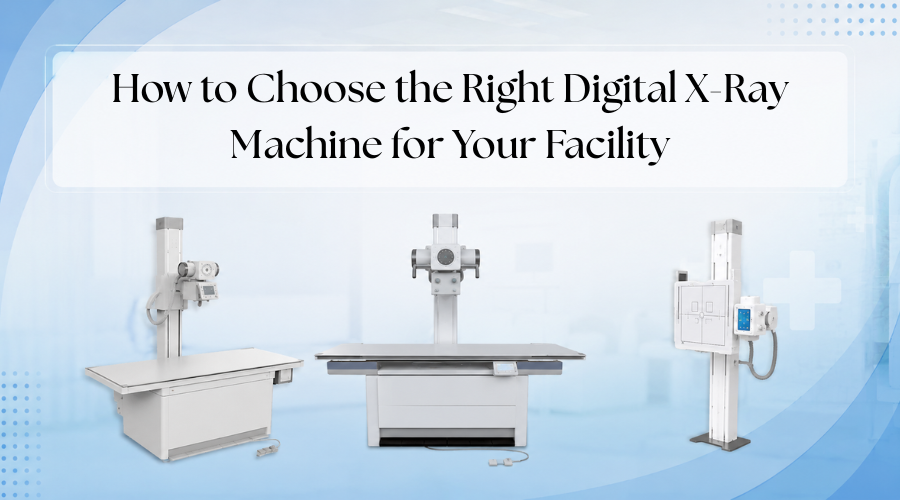
When you need to image 80 to 100 patients a day, you need stability and speed. This is where the fixed room systems come in.
We often see procurement teams engaging in lengthy debates between the electric and manual versions. The way to decide the issue is simple. If your patient mix includes a high percentage of lying down patients, the electric auto-tracking is not a luxury but a workflow necessity. It reduces the physical strain on your technicians, which directly cuts down on positioning time. On the other hand, the manual version is a robust, cost-effective piece of equipment for clinics with lower, predictable volumes. Both options, when sourced from leading high resolution x-ray machine manufacturers, deliver the precision geometry you need. It all comes down to choosing the pace of your workflow operations.
Excessive space occupation is the killer of efficiency, and if your X-ray room is compact with limited square footage, the U-Arm’s isocentric movement lets the tube and detector swing around a single point of interest without changing the position of the patient. It’s elegant and compact. Conversely, a Cross Arm table gives you the flexibility to handle cross-table lateral views quickly. Imagine a busy ER where you can’t just log-roll every trauma patient. Making the right choice here directly impacts your team’s ability to work without physical obstacles.
This X-ray machine has a different configuration entirely. A general radiology machine isn't built for the surgical theater. So, if your work involves orthopedics, pain management, or vascular surgery, your considerations must shift to C-Arm X-ray machines. Our expert advice is to look past the frame and focus on the generator. High-frequency power, precise collimation, and excellent Dose Area Product control are some features that are non-negotiable here. This is machine is for live feedback during a procedure. The image can’t lag, and the dose can’t be an afterthought.
Sometimes, the patient cannot come to you. This creates a unique clinical challenge, and mobile technology is the answer.
The tangled cables, the tight corners make walking through an ICU a hassle. A true portable digital X-ray machine solves this issue with a motorized drive and a single-touch carbon fiber arm. But the real test isn’t the smooth ride down the hallway. It’s what happens when you capture the image. The unit must dump that image wirelessly via DICOM 3.0 straight into your PACS. Immediately. If the Wi-Fi connection fails or the workflow requires five extra clicks, the machine becomes a very expensive paperweight. In short, seamless integration with data connectivity is a must in portable variants.
This is a high demand variant. The machine is a perfect fit for a mobile clinic, moving over rough roads. The biggest mistake we see is buyers treating this like a standard portable with an inverter strapped to a van. You need a system specifically engineered for shock absorption. That is why buying this kind of X-ray machine should only be done through a reliable digital x-ray machine exporter. They have expertise in delivering the chassis, the battery management system, and the generator that is built to survive transit vibration that destroys standard solder joints. This is where rugged engineering meets patient care.
We’ve looked at the different builds. Now, let’s go deeper. The parts you don’t see in the brochure photo are what distinguish a crisp, diagnostic image from a high-dose, noisy one.
This is the single biggest factor in image quality. We know the tech sheets list terms like Gadox and Cesium Iodide. Here is the practical difference. A CsI detector, used by top-tier high resolution x-ray machine manufacturers, converts X-rays to light with a much more focused needle-like structure. What does that mean for your radiologist? Sharper edges. And for your patient, lower-dose exposure. Gadox is cheaper. But in a high-volume hospital, the dose savings from CsI accumulate into a significant patient safety advantage over the life of the panel.
We’ve seen busy hospitals buy a system with a 300kHU tube to save upfront cost. Then the fourth obese patient in a row arrives, and the room goes dark. The system is cooling down. This disruption and delay is an operational hassle that is usually overlooked by buyers in favor of saving the budget. And that decision backfires badly in the long run. For a main radiology room in a hospital, you need a 600kHU tube. This single number dictates your throughput ceiling and efficiency of operations.
User convenience matters a lot in clinical settings, and a difficult-to-use machine means that the technicians will experience frustration in handling the machine, eventually leading to workplace burnout. Repeating an exposure because of a slight positioning error demoralizes a team and doubles the exposure dose. Modern systems embed AI that assists with positioning and centering. It’s not about replacing the tech’s skill. It’s about catching the subtle angle correction that saves a retake. So, once you step in the market to buy an X-ray machine, remember to evaluate systems with user-friendly software and helpful positioning features.
Perhaps the greatest mistake facilities make is to buy a machine suited for one department, then force a completely different specialty to use it. The clinical mismatch causes inefficiencies every single day.
|
Machine Type |
Clinical Operation |
Real-World Advantage |
|
Floor-Mounted U-Arm |
Captures weight-bearing studies (spine, knees, feet) under the patient’s actual load using a tilting table. |
You get true alignment views for orthopedic surgical planning. A stationary wall panel simply cannot do this job properly. |
|
Handles high-speed general radiology and emergency triage with full-room coverage. Uses auto-stitching for long-length scoliosis or leg-length studies. |
One seamless pass covers the entire anatomy. Throughput increases, and your orthopedic colleagues receive the complete picture they demand. |
|
|
Supports interventional surgery with live, moving images. The "pulsed" mode snaps clear pictures of dynamic anatomy. |
Dramatically cuts scatter radiation to your surgical team. This is a direct investment in long-term staff safety during long procedures. |
|
|
Ultra-Compact Portable Digital X-Ray Machine |
Delivers point-of-care imaging for home healthcare, nursing homes, and mobile camps. Operated in tight spaces with lightweight, durable construction. |
Light enough to lift into a vehicle, yet robust enough to survive daily transport. Imaging reaches the patient, not the other way around. |
We know budgets are tight. And we know the fear around global sourcing. "Will the unit get damaged? Will it be compliant?" These are valid fears. But staying local often means paying a premium for technology that can be secured directly through a validated digital x-ray machine exporter.
If you are a multi-site hospital chain or a government procurement body, this has an immediate operational logic. Buying bulk digital x-ray machines doesn't just lower the unit price. It standardizes your biomedical training across three locations. Your engineer only needs to learn one calibration routine. And the greatest cost advantage is that your spare parts shelf serves all three facilities. That standardization slashes your long-term maintenance overhead since you only need one vendor to manage your equipment inventory.
If you are sourcing multiple units you need to be extra careful. The difference between a legitimate partner and a broker is documentation. Your checklist is simple. First, ask for the Factory Acceptance Testing (FAT) report—a video of your actual unit being tested. Second, ask for references from a facility similar in size to yours. A credible digital x-ray machine exporter will have no problem providing these. If they hesitate, you walk away. Third, verify their IHE interoperability profiles. If the unit can’t talk to your PACS perfectly, the savings are irrelevant.
We’re going to be direct here. These are the mistakes that turn a "great deal" into a regulatory headache or a dusty machine sitting in storage.
Ignoring Dose Management Reports: Never buy a system that skips DICOM Radiation Dose Structured Reports (RDSR). This data is vital to decide if the equipment fulfills the patient safety and future accreditation audits.
Overlooking Ambient Temperature: Many imported machines come fitted with cooling systems designed for a climate-controlled lab and not a busy clinic in a tropical region. So, confirm the operational temperature and humidity conditions before you decide to purchase.
Compliance Gap: We need to separate the myth from reality here. Global sourcing is not a "black box" of low quality. The certified high-resolution x-ray machine manufacturers build to IEC 60601-1-2 standards for electromagnetic compatibility. You just need to verify that the specific configuration matches your regional regulatory requirements. The certification sticker must match the final build.
You came looking for a machine. What you actually need is a clinical decision. The right Double Column for one facility might be a workflow nightmare for another. The right C-Arm depends on the generator inside. And the right portable digital X-ray machine is the one that actually connects to your network on the first try. Don’t let the hardware blind you to the integration.
Summary It takes time, which
READ FULLYou are about to wire a significant sum of money to a company you ha
READ FULLA Chinese ultrasonic welding machine distributor may have more advantages than global ones. The r
READ FULL