




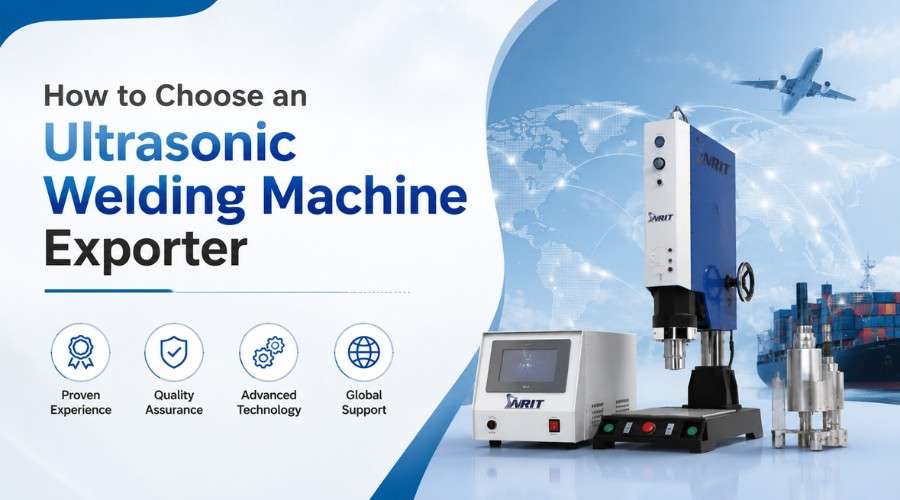
You are about to wire a significant sum of money to a company you have never visited, in a country you may have never been to, for a machine you have never seen run. That is the reality of working with an ultrasonic welding machine exporter, and it deserves more caution than most buyers bring to the table.
On paper, every exporter looks the same. The same glossy photos. The same specification tables with the same promises about quality and service. Yet the gap between a competent manufacturer and a workshop assembling copies is enormous. And you only find that out when you receive the machine at your factory.
This guide gives you a practical evaluation framework to avoid getting stuck with a purchase that you regret in the future. You will learn how to define your application and read a specification sheet critically. You will also learn which quality certifications are essential and which are optional. And we are going to guide you about the commercial terms you must understand that protect you from getting scammed. No theory. Just the checks that separate safe purchases from expensive lessons.
Know Your Use Case Before You Talk to Any Exporter
The single biggest mistake buyers make is shopping for a machine before they understand their own weld. A serious exporter will ask about your application in the first conversation. If a supplier jumps straight to quoting a price, then that is your first warning sign.
Your first consideration should be the materials you work with. Thermoplastics behave very differently under ultrasonic energy. ABS welds easily even if parameter settings are loosely defined. PP and PE are semi-crystalline, which means they need more ultrasonic and tighter tolerances. PVC, PC (polycarbonate), PA/nylon, and acrylic (PMMA) each bring their own material-specific problems, from moisture sensitivity to degradation risk.
Industry quality regulations are a dominant factor that shapes the final product requirements. Automotive components demand repeatability and documentation. In the medical sector, medical device assembly should have validation and traceability.
Write down your material, part geometry, production volume, and industry before you contact anyone. This homework takes an afternoon. But it will save you weeks of miscommunication later.
You do not need to design ultrasonic equipment. But you do need to understand it well enough to spot a supplier who is bluffing. When you review ultrasonic welding machine specifications, here is what actually matters.
The ultrasonic generator converts line power into high-frequency electrical energy. The transducer, sometimes called the converter, turns that electrical energy into mechanical vibration. The booster modifies the vibration amplitude, and the horn (sonotrode) delivers it to your part. The anvil/fixture holds everything in place.
You must ask your exporter who manufactures each of these parts. Horns especially. A well-designed horn is tuned to your part; a generic one delivers cracked housings and inconsistent welds.
Machines typically run at 15kHz, 20kHz, 30kHz, or 40kHz. Lower frequencies deliver more power and suit larger parts. Higher frequencies offer gentler, more precise welding for small or delicate components. If an exporter recommends a frequency without asking about your part size and material, they are guessing.
Amplitude, weld energy, hold time, trigger pressure, and weld cycle time—these parameters determine an inferior-quality weld from a flawless one. These determine whether your weld succeeds. The weld itself forms through frictional heat generated at the joint interface, which is why joint design matters so much. An energy director concentrates that heat for most amorphous materials, while a shear joint works better for semi-crystalline resins. Ask whether your parts need near-field vs far-field welding, since the distance between the horn contact point and the joint changes everything.
Pneumatic presses cost less. A servo-driven actuator gives you precise, repeatable control over speed and force, which works best for demanding applications. Look for PLC control with a touch-screen controller that stores weld recipes and logs data.
Then do this: ask the exporter a technical question you already know the answer to. Their response tells you whether you are dealing with engineers or order-takers.
These are your first filters, but only if you know which ones to demand. ISO 9001 is the baseline and confirms that the machine meets general quality standards. CE certification matters if your factory is operating in the European region. RoHS compliance addresses hazardous substances in the electronics. Make sure to ask for a quality inspection certificate for your specific unit, not just a framed certificate on the factory wall.
Your industry may demand more. For instance, automotive buyers expect IATF 16949 with APQP and PPAP documentation, while medical device buyers look for ISO 13485 and risk management under ISO 14971. The certification combination also varies sharply by sourcing region. The table below maps what to ask for based on your application and where you source.
Good machinery wrapped in bad buyer contract terms still qualifies as a bad purchase. Here is where cautious buyers earn their keep.
Incoterms
Understand where risk transfers. Under EXW, you take responsibility at the factory door, which means you handle everything, including export formalities in the seller's country. Under FOB, the exporter delivers the machine onto the vessel, and you take over from there. Under CIF, the seller covers freight and insurance to your port. For first-time buyers of heavy equipment, FOB usually offers the cleanest balance of cost and control.
Payment terms & conditions
T/T (telegraphic transfer) with a deposit is the norm in an industry. That means 30% down payment and 70% before shipment. To reduce the risk, paying the balance after a pre-shipment inspection is safer. But if you plan on a larger procurement, opening an L/C (letter of credit) is the correct path. That additional documentation adds bank-enforced security.
MOQ and pricing
MOQ (minimum order quantity) for the machines themselves is often just one unit. However, there is an MOQ for parts and components of the machine. These include horns, fixtures, and spare parts that are needed for repairs. If you are outfitting multiple lines or buying for resale, negotiating wholesale ultrasonic welding machine pricing can cut unit costs substantially. Even then, buy a single trial unit first. Always.
Lead time and documentation
The standard lead time period runs 4 to 8 weeks depending on the customization of the machinery design and build. From your end, confirm who handles export documentation and where customs clearance responsibility sits under your chosen Incoterm. This is crucial because if either party lacks the paperwork, the machine can get stranded at the port for weeks.
The Buyer's Evaluation Checklist
Before you sign anything, ask the following qualification questions and only then move forward with the deal.
Did they ask about your material, part design, and application before quoting?
Can they discuss frequency selection, amplitude, and other technicalities in detail?
Do they manufacture horns and fixtures in-house or source them?
Can they produce ISO 9001, CE, and RoHS documents on inquiry as well as unit inspection certificates?
Do they consent to a factory audit?
Do payment terms include inspection before final balance?
Have they quoted realistic lead times with export documentation responsibilities?
Choosing the right ultrasonic welding machine exporter comes down to two aspects: knowing the technology well enough to ask sharp questions, and knowing the commercial landscape well enough to protect your money. Do both, and the sourcing process stops being a gamble.
Your best bet is to start with a trial unit, request a weld sample evaluation on your actual parts, and let evidence replace promises. If you are ready to begin, reach out to shortlisted exporters with your application details in hand and watch how quickly the serious ones separate themselves from the rest.
Summary It takes time, which
READ FULLYou are about to wire a significant sum of money to a company you ha
READ FULLA Chinese ultrasonic welding machine distributor may have more advantages than global ones. The r
READ FULL