




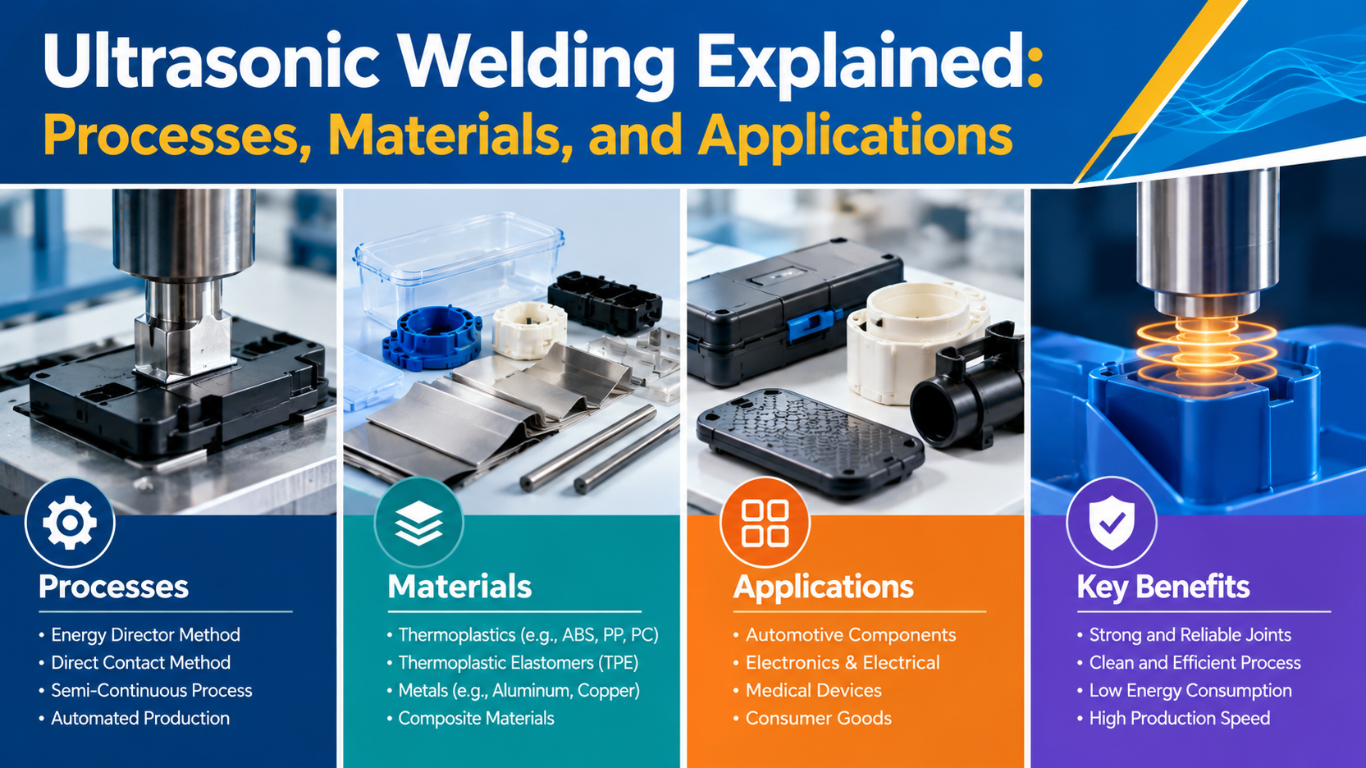
Ultrasonic welding is a high-frequency vibratory joining process. It requires no glue, solder, or filling. Standard frequencies are 15, 20, 30, 35, and 40 kHz. Weld cycles range from 0.1s to 1.5s. It is capable of bonding thermoplastics, aluminum, copper, brass, nickel, and nonwoven fabric. They are primarily used by automotive, EV battery, medical, electronics, and packaging manufacturers. In selecting an ultrasonic welding system manufacturer, look at the frequency range, welding power output, certifications, and customization options.
It is a solid-state welding technique used on thousands of production lines. It's quick, clean, and simple to automate. It completes many cycles in less than a second. The buyers will want more than a simple definition. This guide explains the process, parameters, materials involved, and applications. It also explains how to assess an ultrasonic welding system manufacturer before you place an order.
Ultrasonic welding is a joining technique that generates friction through mechanical vibration, typically in the range of 15-40 kHz. The friction kneads or bonds the surfaces of nonmetals without melting the rest of the part. It is listed in ISO 4063 as process number 41.
The five main components of an ultrasonic welding system have an impact on weld quality. The power supply converts 50/60 Hz mains electricity into a 20 kHz or 40 kHz signal. They are available in a range of power from 300 W to 6,000 W, with heavy metal welders offering the highest power.
That signal is converted to mechanical vibration by the use of piezoelectric ceramics. The booster is used to amplify amplitude by a fixed ratio, generally either 1:1.5 or 1:2. A sonotrode, or horn, is used to transmit vibration to the part. It is cut from titanium (Ti-6Al-4V), aluminum, or hardened steel. Typically, the force applied by a press or actuator is 20 to 2,000 N.
Plastic welding has 4 steps: clamp, vibrate, hold, and release. The horn presses on the upper part with 200 to 1,500 N of force. Vibration travels through the part to the joint. The plastic melts at the interface within 0.2 to 1.0 seconds due to friction.
Most plastic joints feature an energy director: a small, triangular ridge. Its height is usually 0.25 to 0.5 mm on a 2 to 3 mm wall. It is used to concentrate energy and to melt first. Once vibration stops, the part is held under pressure for 0.3–1.0 seconds until it solidifies. Good joints can reach 80%-100% of the base material strength.
Metal welding creates a solid-state bond without melting under vibration and pressure. The horn moves parallel to the joint plane. A knurled tip grips the top sheet. The motion removes oxide films and creates atomic contact between clean metal surfaces. The typical amplitude is 20 to 60 microns. Typical process temperatures are less than 50% of the melting point of the metal. This helps protect heat-sensitive materials. Battery cell foils are 0.01 to 0.2 mm thick; up to 40 or more layers can be welded to one tab, forming a stack. 20 kHz systems above 4,000 W can join aluminum sheets up to about 3 mm thick.
Welding is possible with thermoplastics, non-ferrous metals, and some non-woven fabrics. Amorphous plastics such as ABS, PC, PS, and PMMA weld easily. Semi-crystalline plastics such as PP, PE, PA66, and POM need more energy. Common metals are aluminum, copper, brass, and nickel.
The parameters that affect weld quality are amplitude, force, time, and energy. The amplitude of plastic is typically 20-100 microns per 20 kHz and 10-40 microns per 40 kHz. The range of weld force is 50 to 1,500 N, and the range of weld time is 0.1 to 1.5 seconds. Energy per weld varies from 5 J on small parts to 3,000 J on large ones. Frequency choice matters. A 20 kHz system is appropriate for large parts with thick walls. A 40 kHz system can be used for small, delicate parts as employed in medical filters and sensor housings, in which lower amplitude results in reduced marking. A 15 kHz unit works on very large or highly damped parts. The 30 and 35 kHz units are in the middle.
Ultrasound welding offers speed, cleanliness, and repeatability. High-volume lines call for a cycle of 0.5 to 2 seconds. It requires no consumables, keeping the cost of each weld low, with no fumes, solvents, or curing time. Energy is drawn only during the weld. The process is limited. A 20 kHz horn is limited to about 300 mm of joint length. Elastomeric materials are soft, prone to vibration, and bond poorly. Dissimilar plastics must be chemically compatible. The welding speed of steel and titanium is not easy to achieve. There is a high entry cost at low volumes, as tooling for each part shape must be made.
Automotive, medical, electronics, packaging, and energy are a few industries that apply ultrasonic welding. It connects up to 120 mm² of wire harness cables in auto plants. It's also employed on plastic door panels, plastic filter housings, and lamp assemblies. It is employed to join copper or aluminum tabs to the EV battery foils and busbars. It is applied in medical products such as surgical masks, IV filters, and diagnostic cartridges. All of these lines run in a Class 7 ISO cleanroom inside ISO 13485 quality systems. Electronic device assembly combines sensor cases, connectors, and charger cases. Food packages, tubes, and blister packs are sealed on the packaging line without any glue or heat-sealing bars.
Good joint design can avoid most weld defects. Balance the wall thickness to be 1.5 to 3.0 mm for plastic housing. Parts fit tightly, with less than 0.1 mm clearance; prevent parts from vibrating by using alignment features. Common defects are flash, surface marking, unsound welds, and cracks. Marking and cracking result from excessive amplitude. Strong bonds can form with low amounts of force. The misaligned horn gives an imbalanced energy. If PA66 is welded the same day that it is molded or is stored in a moisture-free environment, the joint will be stronger.
Select a manufacturer for the ultrasonic welding system who offers a range of frequencies, in-house horn design, ISO 9001 certification, and CE marking in accordance with Machinery Directive 2006/42/EC. Request sample welds of your parts, along with test data.
Ultrasonic welding provides easy, rapid, repeatable joints with plastics and non-ferrous metals. Success is achieved through matching frequency, amplitude, force, and joint design to the material. Order samples, check out the specs, and verify lead times before buying.
Where do you get ultrasonic welding machines in bulk for retail?
Purchase from an ultrasonic welding system manufacturer who can provide a product line with multiple frequencies, distributor terms, and a minimum order of 5 to 10 units.
How much do ultrasonic welding machines cost wholesale?
The initial price of wholesale plastic welders ranges around USD 4,000 and increases to over USD 100,000 for plastic-metal automated welding lines.
Who is a custom supplier of ultrasonic welding systems with discounted rates?
Check for a manufacturer that can create a custom horn, fixture, and controller in-house and can discount the cost if the horn is ordered again.
Who supplies both bulk and customized ultrasonic welding systems from one source?
Select a manufacturer that offers both standard catalog and custom-built models that are run on the same production line.
Highlights Ultrasonic welding
READ FULL