




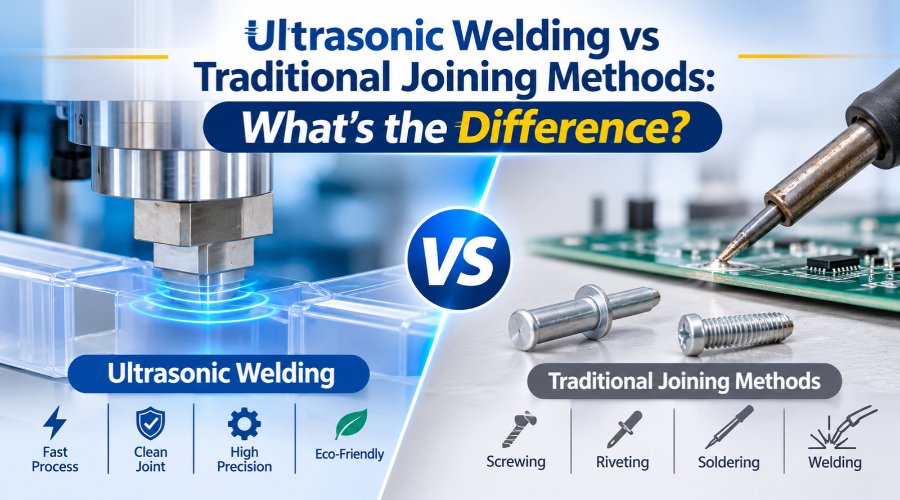
There are like tens of welding types that exist in the industry, and ultrasonic welding is one of them. If you compare it with others, there will surely be lots of factors to consider. Keep in mind that an ultrasonic welding machine works only on thermoplastics, so if we compare it with the traditional types that work on the same material, it will be fair. So, before you choose an ultrasonic welding machine distributor, you need to read a comparison that can help you decide better. It is about investing in fixed assets, and you do not want to make any mistakes in it. Also, have a look at these Chinese Ultrasonic welding machine distributors who might be a more cost-efficient solution for the buying process.
There is a type of welding that does not operate through heat, and it is ultrasonic welding. It is one of the solid-state welding types that provide fast and clean output. Since it welds through mechanical oscillation and pressure, it is compatible only with plastic objects. For instance, you can find a 15 kHz ultrasonic welding machine that welds larger, heavy-duty plastic parts. This welding type works best on PVC, ABS, PET, PE, PP, and PC, acrylic, cellulose, and every other plastic type.
If you are still not clear on how it works, here is a detailed version of how ultrasonic welding works. The ultrasonic welding frequency range usually goes from 15 kHz to 40 kHz. Lower frequency is for large and heavy-duty parts, and higher frequency is for compact parts. This is why a 20 kHz ultrasonic welding machine will be a better choice for medium parts than a 15 kHz type. Likewise, a 40 kHz machine is best for compact parts that require high precision, concentration, and focus. Here, you can also learn how to choose an exporter who deals in ultrasonic welding machines.
On the other hand, there are many traditional joining methods that use both heat- and cold-based methods. Arc welding, resistance welding, fusion/electron beam welding, and stud welding are some of the types you can find in the industry. There are also subcategories of each type because the range is very extensive if we go into detail.
Most of these traditional joining methods are for metallic surfaces, and only a few are for plastic surfaces. Since we are comparing with ultrasonic welding, let’s keep it to plastic surfaces only.
You can understand their core differences when we specifically compare them through each of the following factors. These factors will help you understand which welding type will be suitable for you in your applications. Keep in mind that we are comparing both types of welding based on welding on plastic parts.
Ultrasonic welding is compatible with plastic materials only. It can weld only plastic pieces with another plastic piece through an oscillating process at a specific frequency level. Traditional welding has a wide variety, but we will compare it only with the ones that weld plastic parts. These examples are extrusion welding, hot plate welding, and hot gas welding. All these types, including ultrasonic welding, are compatible with thermoplastics.
When we compare both types, traditional joining methods are more portable. Hot gas and extrusion welding types are more portable than ultrasonic welding. Even these two types are easy to use due to their high portability.
Both types provide cleaner welding quality since they do not have any sparks or burnt marks. Since we are comparing only plastic-compatible traditional welding, there is no need for lasers or sparks. On the other hand, ultrasonic welding is free of heating, which makes it a cleaner option.
This is where ultrasonic welding has the biggest advantage over the rest of the types. It provides much faster results, within a few seconds. Unlike other types, it does not need time to melt down the thermoplastics because it uses oscillating functions to weld plastics. There is no heat or waiting time to melt both plastic pieces. All it needs is pressure to weld both plates within a few seconds. Buyers who are looking for this type, here is what they need to consider when choosing a manufacturer for a high-frequency welding machine.
Then we have another major factor that makes a huge difference between ultrasonic and traditional methods. In ultrasonic welding, there is no need for preheating or additional material to melt for welding. It needs no heat or any supporting material to weld two parts together. Its primary ultrasonic feature is enough to do that in a few seconds.
The cost of operation is the third major factor that makes a significant difference. Since there is no need for preparation like heating or additional material, the cost of operation also drops. The ultrasonic welding method consumes around 50% less energy than traditional methods. This is why it is a more cost-efficient welding method when it comes to thermoplastic parts’ welding. Since most solid-state welding types are cost-effective, ultrasonic welding is one of them with the highest efficiency.
In the end, you will be able to decide which one is more suitable for you. We provided an extensive comparison in terms of functionality, cost, quality, speed, and additional factors. It is up to you because you will need to make sure the machine is compatible with your application. There is another factor, which is initial investment, where an ultrasonic machine might be costly, but you will have to look at the big picture. The ROI, durability, operational support, and lots of factors are part of the selection process.
You can find many manufacturers, and Chinese manufacturers have similar quality at lower prices. Suzhou New Rising Intelligent Technology Co., Ltd. is one of them. If you explore its quality, price, and support services, you might prefer to buy from it. It is a wholesaler with highly compatible 15 kHz ultrasonic welding machines.
You need a manufacturer who has a feasible price and compatible quality. Try Suzhou New Rising Intelligent Technology Co., Ltd. It might meet all your requirements regarding a 20 kHz ultrasonic welding machine.
It depends on the type of welding you want to perform and compatibility with thermoplastics. Ultrasonic welding machines are cost-efficient, but only if they are compatible with your application. They provide much faster, cleaner, and more cost-efficient welding compared to other types.
Highlights Ultrasonic welding
READ FULL