




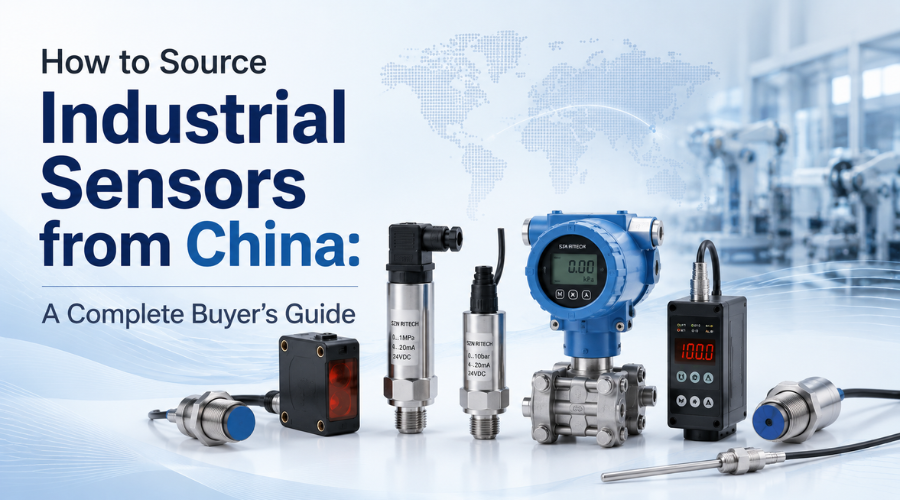
If you have been keeping up with the trends in industrial sourcing over the past few years, you would have likely noticed a steady shift. Procurement managers who once defaulted to European or North American suppliers are now looking eastward with serious intent. This is not about chasing the lowest possible price. Rather, it is about the real value that they are getting from their industrial smart instrument manufacturers in China.
Consider the stats first, because they reveal the full picture. An average Chinese sensor manufacturer prices its products 15 to 25% below the products offered by Germany, Japan, or the United States. On its own, that margin might raise suspicions about quality. But that low price point is completely justified by short production lead times, flexible MOQs, and engineering support.
The scale of China's export machinery is another factor that deserves your attention. In 2025, the country exported over $49 billion worth of online monitoring equipment and industrial sensors—a year-over-year increase of more than 18 percent. Furthermore, Chinese manufacturers now account for nearly one-third of the global industrial sensor market, which itself surpassed $138 billion. These are not the figures of an immature or unreliable sector. They reflect years of investment in production infrastructure, quality control systems, and export logistics.
What makes your industrial sensor sourcing task easy is the geographic specialization that has emerged across China's manufacturing regions. You see, Chinese industrial development did not happen uniformly; different provinces developed distinct competencies based on local industrial heritage and talent pools.
In Shanghai, for instance, you will find suppliers focused on automation sensors like proximity detectors, optical units, and components tailored for automotive and robotics applications. Conversely, if your procurement consists of temperature monitoring or environmental sensors, Guangdong province, particularly the Shenzhen-Foshan corridor, will be more suitable since they offer manufacturers sensors that excel in waterproof probes with IP67 ratings and Modbus RTU communication protocols.
The list of province-specific specializations does not stop here. If gas detection, electrochemical analysis, or moisture measurement sensors are your need, Shandong province has built a strong reputation. And if your demand consists of linear displacement or resistive sensors for test equipment, you would do well to investigate suppliers in Zhejiang and Jiangxi.
Understanding these regional strengths should be the foundation of your sourcing strategy. This will also help you immensely in OEM industrial instrument sourcing. By matching your application requirements to the right geographic cluster, you effectively narrow your supplier shortlist from thousands of possibilities to a manageable handful of genuine specialists.
Once you have identified a few suppliers in the right region, the real work begins. Evaluating a factory from thousands of miles away requires a systematic approach. Your goal here is to verify not just what the supplier claims to do but what they can actually deliver, consistently and at scale.
This is the first thing you should look for. A top-tier supplier should offer a lineup of five core sensor categories: proximity, optical, ultrasonic, temperature, and environmental sensors. And within those categories, they should have more than twenty distinct variants. This diversity showcases the depth of engineering expertise the supplier has. In addition to this, you need to confirm the compatibility of the sensors upfront.
Beyond technical expertise, what matters most for sourcing is supply reliability. Getting superior quality without any guarantee that your inventory levels will stay filled is just as bad as getting a useless inferior quality product. And this is where you need to adopt a procurement manager's mindset rather than an engineer's. Request real-time performance data from the supplier, and do not accept vague assurances. Ask for their on-time delivery rate—anything below 98% should raise immediate questions about their production planning and logistics management.
One of the most telling metrics, however, is the reorder rate. If a supplier's existing customers are coming back for more, with a reorder rate above 20 percent, then that is a strong signal of satisfaction. Another way to know that a sensor manufacturer is well-established and can maintain a steady supply is by asking about their annual online revenue. Suppliers generating over half a million dollars annually through verified platforms like Alibaba have typically established export operations and understand international compliance requirements.
Before you make a deal, you need to understand if your contact is with the actual manufacturer or a trading intermediary. This difference matters enormously for pricing, customization flexibility, and quality control. A genuine manufacturer should be able to provide photographs of their production setup and in-house calibration laboratories. Trading companies, by contrast, often struggle to provide this level of transparency because they do not control production directly.
Another criterion that you should definitely not skip in your selection process of a sensor manufacturer is a review of certifications. Verify that the certifications are current and relevant to your industry. ISO 9001 is a baseline for quality management, but if you are sourcing for automotive applications, IATF 16949 certification carries more weight. For sensors destined for hazardous environments, ATEX or IECEx certifications become a necessary benchmark for environmental sensors built for hazardous environments.
Once you have shortlisted promising suppliers, you will inevitably spend considerable time reviewing datasheets and technical specifications. This is where many procurement managers make costly mistakes—not because they lack technical knowledge, but because they assume all datasheets will be complete. They are not.
A complete sensor datasheet must include several essential types of information. First, the electrical characteristics: supply voltage range, output signal behavior, and power consumption figures.
Second, environmental ratings: the operating temperature range, dust and water protection or IP rating, and any chemical resistance specifications if the sensor will be exposed to corrosive substances.
Third, mechanical specifications: dimensional drawings with tolerances, mounting conditions, cable length, and connector types.
Performance metrics of sensors printed in the datasheet reveal the actual performance of the sensor during operation, so remember to analyze them. Look for hysteresis values, repeatability figures, response times, and warm-up periods. These numbers directly impact how reliably the sensor will perform in your specific application.
However, reading a datasheet is only one part of the equation. You must also cross-check the claims against real-world operation. For that, you need to request test reports from the sensor supplier demonstrating performance under actual operating conditions. Suppose you are ordering an infrared temperature sensor. For this, you would want to see thermal accuracy within plus or minus one degree Celsius across the specified range. Do not hesitate to ask for electromagnetic interference and electromagnetic compatibility validation as well. Industrial environments are notoriously noisy, and a sensor that performs perfectly in a lab may fail on a factory floor.
Pricing negotiations with Chinese suppliers can be complex, but they follow predictable patterns once you understand the underlying dynamics. Your approach here should be strategic: seek competitive pricing without compromising quality.
Pricing varies significantly across sensor types and customization levels. The table below provides a comparative snapshot based on verified supplier data, giving you a realistic benchmark for your negotiations.
|
Supplier Location |
Sensor Type |
Price Range (USD) |
MOQ |
Key Features |
|
Guangzhou |
DS18B20 Temperature Sensor |
$2.10 – $10.00 |
10 units |
IP67 rating, Modbus RTU |
|
Zhejiang |
Proximity Sensor (NPN) |
$1.90 – $5.00 |
2 units |
Compact design, low power consumption |
|
Shanghai |
PU15 Proximity Sensor |
$16.45 – $20.00 |
1 unit |
15mm sensing distance, industrial grade |
|
Jiangxi |
Linear Position Sensor |
$15.00 – $18.00 |
2 units |
Resistive, miniature form factor |
|
Foshan |
LVDT Linear Sensor |
$10.00 – $13.00 |
1 unit |
100mm stroke, high stability |
|
Shandong |
Phosphine Gas Sensor |
$222.00 – $243.00 |
1 unit |
I2C/RS485, high-precision detection |
Minimum order quantities, or MOQs, are another factor that you must negotiate with care. For standard off-the-shelf sensors, suppliers often set MOQs at 300 to 500 units. However, many manufacturers offer single-piece sampling for testing purposes. Such an offer allows you the chance to validate performance before committing to larger volumes. If you plan on ordering custom designs, MOQs rise to 1,000 to 5,000 units, reflecting the tooling and engineering setup costs involved.
You should be clear regarding the trade-offs between customization and cost. A custom sensor designed specifically for your application can provide significant competitive advantages, but it will command higher unit prices and require larger initial orders. On the other hand, if you choose a standard off-the-shelf sensor that closely matches your requirements, it may limit your differentiation but offers faster delivery and is more budget-friendly. Weigh these costs and benefits carefully based on your project timeline and budget constraints.
Getting the HS Code Right
Logistics may not be the most exciting part of the sourcing process, but it is where many well-planned procurement strategies start to fail. Getting your sensors from a factory in Guangdong to your warehouse in, say, Rotterdam or Chicago requires careful attention to classification, documentation, and shipping method selection. A single misstep can result in customs delays or damaged goods.
For import compliance, look to the Harmonized System code, or HS code, for guidance. Correct classification determines the duty rate you will pay and any regulatory requirements you must meet. The table below outlines the most relevant HS codes for industrial sensors, helping you avoid costly misclassification errors.
|
HS Code |
Category Description |
Common Products Covered |
|
90318000 |
Measuring/checking instruments, not elsewhere specified |
Proximity sensors, vision sensors, general-purpose industrial sensors |
|
9026 |
Flow, level, pressure measuring instruments |
Pressure sensors, flow meters, level gauges |
|
902620 |
Pressure measuring instruments |
Manometers, pressure transmitters |
|
902680 |
Other measuring instruments |
Gas flow meters, heat meters |
|
902610 |
Flow or level checking instruments |
Electromagnetic flow meters, ultrasonic level sensors |
Lead times are another factor to plan for. Production turnaround time for sensors is usually 15 to 30 days for bulk orders. For shipping, you have two primary options: air freight, which delivers in 5 to 7 days globally but costs more. Sea freight, which is more economical for container-sized orders, has a major drawback: significantly longer transit times. For deciding between the two, consider your urgency, budget, and the volume of goods being shipped.
You need to take the issue of packaging requirements seriously. This is because precision industrial sensing devices are fragile and require extra protection. Breakage and damage risk is really high during transportation. Industrial sensors are sensitive to vibration, electrostatic discharge, and temperature fluctuations. So safeguarding them requires packaging that delivers triple safety, consisting of anti-static foam packaging, shock-absorbing liners to protect against impact, and desiccant packs to control humidity.
Finally, clarify your Incoterms with the supplier/manufacturer before shipping. "Free on Board," or "FOB," terms mean the supplier delivers the goods to the port of departure, and you bear the responsibility for freight, insurance, and customs clearance. Delivered Duty Paid, or DDP, terms shift those responsibilities to the supplier so they handle shipping, customs clearance, and duty payment. Many Chinese suppliers now offer DDP terms, which can be a substantial advantage for buyers who want a simpler approach.
Experienced procurement managers know that the contract signing is not the finish line; it is the starting point of a long-term relationship. After-sales support and warranty terms often determine whether that relationship remains collaborative or not. You should therefore clarify these terms in writing before you commit to an order, not after problems arise.
Warranty periods in the industrial sensor industry range from 12 to 24 months from the date of shipment. The precise duration matters less than what the warranty actually covers. Does it include manufacturing defects only, or does it also address calibration drift, firmware issues, and environmental failures? A supplier who covers a broad range of failure modes is demonstrating confidence in their product quality.
Return policies are equally important. Who covers return shipping costs for defective units? Who bears the expense of replacement shipments? Some suppliers offer immediate advance replacements while they evaluate the returned goods; others insist on completing their failure analysis before sending replacements. The former approach minimizes your downtime, but it also reflects a higher level of supplier trust and operational capability. If the supplier is unwilling to offer reasonable return terms, consider that a warning sign.
Technical support capabilities also vary widely among Chinese suppliers. Some maintain dedicated engineering teams that respond to queries within business hours across multiple time zones; others treat technical support as an afterthought. Before you sign, evaluate their firmware update procedures—can they provide over-the-air updates or field upgrade kits? Do they stock spare parts such as replacement probes, cables, and connectors for at least the warranty period? These considerations are particularly relevant for sensors that operate in critical industrial processes, where downtime costs far exceed the price of the sensor itself.
Your Seven-Phase Roadmap
To consolidate the guidance provided throughout this guide, here is a sequential workflow you can apply to your next sensor sourcing project. Treat it as a living checklist—one that you refine with each new supplier interaction.
Phase 1: Shortlisting – Map your application requirements to China's regional specializations. By the end of this exercise you will easily have a list of five to ten candidate suppliers that match your sensor type, protocol needs, and certification requirements.
Phase 2: Technical Verification—Request and review datasheets, certifications, and test reports. This is vital for ensuring the sensors are compatible with your operational environment and control system architecture.
Phase 3: Supplier Performance Assessment—Gather performance data on delivery rates, response times, and reorder rates. Distinguish manufacturers from trading companies through transparency requests.
Phase 4: Sampling – Order samples and test them under actual operating conditions. Document performance against specifications and compare across multiple suppliers.
Phase 5: Commercial Negotiation – Define pricing, MOQ, payment terms, and warranty coverage. Negotiate milestone-based payments and leverage escrow for initial orders.
Phase 6: Logistics Planning – Confirm HS codes, Incoterms, and shipping methods. Arrange for appropriate packaging and documentation to protect sensitive instruments during transit.
Phase 7: Post-Sale Setup – Establish technical support channels, firmware update procedures, and spare parts availability. Document escalation paths for quick problem resolution.
Sourcing industrial sensors from China is not a one-off transaction; it is a strategic capability that, when executed well, gives you a sustained competitive advantage. The benefits of the China sensor market, like the abundance of suppliers and manufacturing expertise, are for everyone. Your role as a procurement manager is to navigate this market with a shrewd, risk-aware mindset. You need to verify claims, test performance to uncover Chinese factory sensor quality, and build relationships that extend beyond the first order.
By following the sourcing tips outlined in this guide, you can source sensors that arrive on time and perform reliably in the field, maximizing the benefits that China's industrial ecosystem offers for your business.
Summary It takes time, which
READ FULLYou are about to wire a significant sum of money to a company you ha
READ FULLA Chinese ultrasonic welding machine distributor may have more advantages than global ones. The r
READ FULL