




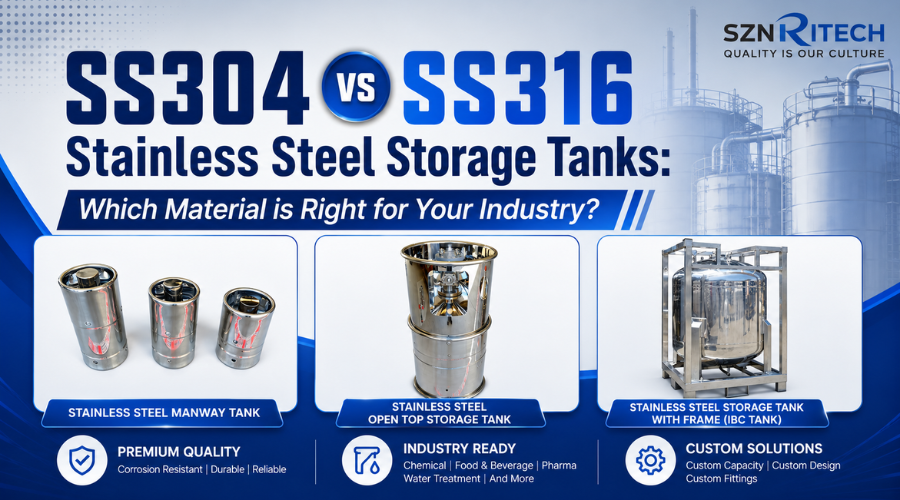
Lots of grades of stainless steel exist in industries, and each grade has some pros and cons. Selecting the grades on the basis of a few elements is never the right scale of analysis. It is better to look at every factor that can affect the performance of tanks and the liquids or solids you store in them. Hygiene and formula stability are the two primary requirements of industries, and they can never compromise on them. This is why choosing industrial stainless steel storage tanks requires a comparative analysis. Since you need assistance in the selection process between grade SS-304 and SS-316, you need a simple guide. Here is the guide for you, which will clarify everything in a detailed way.
304 is one of the most highly trusted grades of SS, which makes it a fine choice for storage tanks. Industrial and commercial users trust this grade because of some primary factors. These factors are durability, resistance strength, affordability, and versatile compatibility with industries. The 304 grade is also compatible with custom stainless steel tanks because of its excellent fabrication. This popular type of austenitic stainless steel is a perfect choice for basic applications where the environmental threats are mild. Here are all the factors that will help you understand SS 304 storage tanks’ durability.
You will understand things better when you know about SS 304’s composition. It has around 65%-70% iron, 18%-20% chromium, and 6%-8% nickel. Besides, it contains some other metals like silicon, manganese, etc. All these elements contribute to making this grade a reliable choice for industrial stainless steel storage tanks.
Since 304 has high malleability, weldability, and machinability, manufacturers find it convenient in the manufacturing process. These elements reduce challenges in production, and the cost becomes less than SS 316. Therefore, many basic industrial applications find simple compatibility with SS 304 storage tanks.
SS 304 gives good protection from corrosion. It makes its storage tanks suitable for residential, commercial, and industrial purposes. Both standard and custom stainless steel tanks meet all the requirements for potable water. Long-term use does not cause any risk of corrosion in SS 304 tanks. As a result, they provide high corrosion resistance to water and mild liquids. Their limitation starts against acids, salts, and similar corrosive liquids. SS 304 is not an efficient choice for highly corrosive liquids.
Since it is a type of austenitic stainless steel, it already provides protection against microbial growth. SS 304 storage tanks resist microbial growth for a long time, and there is not much need for frequent maintenance. Industrial stainless steel storage tanks that have to face various kinds of liquids may need periodic maintenance against the slightest risk of microbial growth.
Besides, SS 304 storage tanks show a good to excellent level of resistance to microbes, bacteria, and fungi. Food and beverage industries can trust 304 grades for storage tanks because they have natural resistance to microbes. Milk and similar beverages, along with food products, can remain safe for storage and mixing in these tanks.
Almost every grade of steel can withstand high temperatures, and austenitic grades do the same. 304-grade storage tanks have a temperature resistance range up to a maximum of 925 degrees Celsius with oxidation resistance. Higher temperatures can compromise oxidation resistance. That means SS storage tanks may lose their corrosion-resistance ability if they experience extreme heat continuously.
Likewise, consistent extreme temperatures can reduce the oxidation resistance of 304 tanks even if they are custom stainless-steel tanks. The moment SS-304 tanks cross 425 degrees Celsius, they start to become susceptible to losing their corrosion-resistance ability upon consistent repetition.
• It is time to know about what kind of industries prefer 304-grade for SS storage tanks. It is for every potable water and non-corrosive liquid and food storage process. Milk, juices, and similar mild food and beverages that have a mild nature get the best and safest storage from SS-304 tanks. Both storage and mixing operations are compatible with these consumable goods.
• Similarly, these storage tanks of 304-grade are compatible with mild and non-corrosive chemicals in medicine production. The pharmaceutical industry uses these tanks for basic and mild formulations.
• In every sector, a potable water storage facility is mandatory, and this grade is safe for it. SS-304 is completely safe for potable water storage, but not for salty or chloride water.
• Even commercial kitchens use them because they are safe, hygienic, and cost-effective storage facilities for food and beverage storage.
They can last over 2 decades and even more. Since they resist corrosion and microbial growth, the durability of austenitic SS storage tanks is longer. SS-304 tanks may need some periodic maintenance in industrial and commercial operations because of non-water applications. Still, the corrosion resistance makes them last for decades.
Now we will discuss the strengths and some limitations of SS 316 storage tanks. Just like 304, SS-316 grade is also a type of austenitic stainless steel. It has higher strength and durability, which makes it a more robust material than 304. However, the cost is higher, which is because of various reasons. This cost makes the 304 grade a more affordable choice. But what makes industries choose these 316 industrial stainless steel storage tanks besides 304-grade? Find out every reason in the following sections.
From the composition of 316-grade, you will find why its storage tanks are more reliable in some industrial applications. It contains 65%-70% iron, 18%-20% chromium, 6%-8% nickel, and 2% molybdenum. The rest of the elements, like silicon and manganese, remain the same. The real difference comes from the addition of molybdenum, which is 2% to 3%. That addition makes this grade superior for both standard and custom stainless-steel tanks.
However, it also causes challenging fabrication and high cost of production. This is why the price of SS-316 tanks is higher than that of SS-304. But again, the benefits pay off in the form of higher corrosion resistance and durability.
The corrosion resistance is what makes 316-grade superior to 304. The level where the limitations start for 304-grade is where the real strength of 316 begins. The molybdenum’s addition of molybdenum gives storage tanks higher resistance to corrosion in most extreme environments. The marine environment can cause severe damage to SS-304, but not to SS-316.
SS-316 storage tanks resist massive pitting corrosion and crevice corrosion. This is what makes this grade superior to 304. SS-316’s non-porous and non-reactive nature makes it an ideal choice for industrial stainless steel storage tanks.
Similarly, grade 316 has high protection from salt water, chlorides, and even harsh chemicals. That means industries rely on this grade against every kind of corrosion. We can say that 316-grade storage tanks are the best choice for salt water, corrosive chemicals, the marine environment, and chlorinated liquids.
The temperature resistance of both 304 and 316 is similar if we compare them. The problem starts when SS-316 storage tanks start losing their superior corrosion resistance in consistent exposure to heat. SS 316’s prime advantage of having a wide range of corrosion resistance could be compromised in extremely hot temperatures. You can consider it a drawback for both SS 304 and SS 316 storage tanks.
Here comes another major advantage of 316 storage tanks. They not only resist massive and wide-ranging corrosion, but they also resist microbes. They can resist algae, microbes, and lots of similar threats because they have molybdenum. Grade-316 industrial stainless steel storage tanks hardly need maintenance, but industries periodically do so to keep their food and beverage quality consistent. The non-porous and non-corrosive surface of these tanks is ideal for food, beverage, chemical, and pharmaceutical products. Such products have corrosive elements that may react easily with 304 tanks but not with 316.
• Now, you will find out better why SS-316 storage tanks are preferred even though they are expensive to manufacture. Pharmaceutical mixing tanks use them because they keep the medicinal chemicals non-reactive inside. These chemicals can not react with the surface of tanks since they have molybdenum. That element repels every risk of corrosion of every kind.
• Chemical industries use 316-grade tanks because they seek the same performance. They know that corrosive chemicals can not react with the SS316, which is why the tanks become safe and reliable. Storage and mixing operations at large scale become safe from every kind of reaction between chemicals and metal. The hygiene remains at the top, as does the stability of chemicals.
• Marine and coastal installations need heavy-duty and non-corrosive tanks, where 316-grade qualifies. These tanks are the best choice compared to SS-304 against salt and harsh elements in marine environments. Salt and corrosive liquids and solids remain ineffective for every mixing and storage operation.
• Even highly sensitive materials in the biomedical industry need storage tanks where there is no contamination risk. 316-grade tanks qualify for these conditions where hygiene is a priority.
• Similarly, the wastewater treatment in some industries requires stainless steel tanks. SS 316 tanks are the most compatible type for this application. Waste water contains lots of highly reactive elements that need something like SS-316 storage tanks for safe treatment and discharge process.
• 316-grade tanks are safe for water, food, and other beverages, but industries prefer 304 because of the cost factor.
The durability of SS 316 tanks is longer than that of SS 304. They can last over 2 to 5 decades depending on the environmental conditions, maintenance, and applications. Basic and mid-level threats may not affect these tanks much, which means the durability could be much higher.
The selection of stainless-steel storage tanks requires lots of analysis because there are many factors to consider. Durability, performance, cost, and a range of compatibility affect the selection process. When we compare storage tanks of SS-304 and SS-316, we have to discuss lots of factors. In summary, we can say that SS-304 storage tanks are a better choice for potable water along with non-reactive food and beverage storage operations. This grade is more cost-effective for non-reactive and mild storage elements.
However, if it is about highly corrosive liquids and solids, SS-316 storage tanks are the best. They are less cost-effective but show superior performance against salts, acids, and harsh corrosive chemicals. Besides, both 304 and 316 SS storage tanks are not suitable for consistent extreme heat. Doing that will reduce their anti-corrosion properties.
Which Industrial Stainless Steel Storage Tanks are Better for Harsh Liquids: SS 304 or SS 316?
SS-316 storage tanks are an excellent choice for harsh liquids. They contain 2% to 3% molybdenum, which makes them resist every corrosive element like water, salt, acid, etc.
Are SS 316 Storage Tanks Better for Salt Water and Marine Applications?
Yes, they are better for saltwater and marine applications. Their superior resistance makes them an excellent storage choice in extremely corrosive environments. The environment as well as the liquid/solid inside the tank will not cause any damage.
Which Industrial Stainless Steel Storage Tank is Cost-Effective for Potable Water: 304 or 316?
SS-304 tanks are a cost-effective choice for potable water. 316-grade has high resistance to every corrosive element, which makes it a costly option. It is better to choose a cost-effective grade for potable water, which is 304.
Which Grade of SS Storage Tank Can Survive Longer in Extreme Heat?
Both 304 and 316 grades can survive extreme heat, up to 900 degrees C. However, the problem starts when they start losing their anti-corrosion protection upon consistent exposure above 425 degrees C.
Does Consistent Extreme Heat Reduce Corrosion Resistance in SS Storage Tanks?
Yes, consistently extreme heat over 425 degrees C can reduce corrosion resistance in SS storage tanks. Both 304 and 316 grades start losing their corrosion-resistance strength in this condition.
Summary It takes time, which
READ FULLYou are about to wire a significant sum of money to a company you ha
READ FULLA Chinese ultrasonic welding machine distributor may have more advantages than global ones. The r
READ FULL