




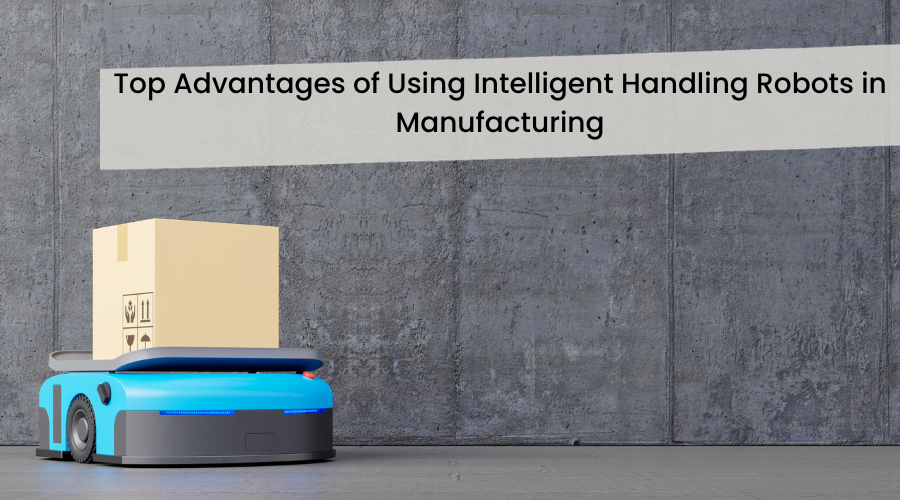
E-commerce is all about faster ordering, processing, and delivery. The way a website or application has to be user-friendly, its backend operations in the supply chain also have to be efficient. To maintain a fast pace, some industries now replace every laborer with an Automated guided vehicle robot . It is happening in sectors to reduce the cost of repetitive tasks. Robots are good at it, and you can understand their worth in this blog.
It is an advanced material handling system that relies only on robots. Mega manufacturers that have to deal with thousands and millions of goods daily require such automated material handling systems. Such companies look for machines like robotic arms, AGVs, AMRs, and some other types for faster operations. They are slowly switching to full automation, which is also increasing the demand for a handling robot exporter in every sector. Industries look for agility in material movement, which comes better from robots. Therefore, an automated material handling system meets their requirements for a cost-effective solution.
Since this automated system is slowly taking over all industries, let’s find out about its benefits.
In every country, there is a problem known as inflation. Whenever inflation increases, it affects the labor cost. Therefore, industries also have to increase wages to provide a bare minimum earning. If we look from a manufacturer’s point of view, everyone wants to reduce production costs. That includes material handling cost, which is directly related to labor cost.
Since laborers need training when they join and timely replacement when they leave, these factors increase the overall production cost. Therefore, industries are replacing laborers with intelligent material handling robots. These robots are cutting off a substantial labor cost, which is directly affecting the profits. Find more in the following explanations.
If we compare the laborer’s training cost with the robots’ integration cost, the latter is cheaper and more reliable. An integrated robot will not leave an employer, but a trained laborer will. Therefore, the integration cost is low, and the retention is durable. Once intelligent handling robots are integrated with the warehouse management system, all a company has to do is wait for the results. Every smart warehouse handling robot provides consistent performance since all of them get the same software. Then the consistency and efficiency go in a parallel way. The same case is with ASRS (Automated Storage and Retrieval System), which works just like it was designed to do.
Different laborers may have different wages at the same working grade. Everyone knows about it, but the case with robots is different. The operational cost will be lower in a robotic warehouse system because all the robots will require the same energy input to run. It will be a much more cost-effective solution than manual labor.
This is why many ask, “Are AGV robots replacing human workers?” Well, not yet, but possibly soon. If we go into detail, the working conditions also matter because many sectors can’t rely on robots no matter how advanced the world becomes.
Then there is no issue about workforce shortage. For instance, there is a political turmoil or disease outbreak, and an entire or at least half workforce might fail to reach work. Now, there will be a severe shortage of workers for a manufacturer or service provider. That is what we have witnessed in the pandemic of 2020. In such situations, it is hard to keep the workforce active for work because political turmoil, such as strikes and riots, also create a severe absenteeism at work.
However, a warehouse with intelligent handling robots’ force cannot suffer like that. Companies can operate this automated force remotely. It will make them ineffective in the face of medical, political, and similar uncontrollable external events.
Some materials are highly sensitive, which require advanced training and equipment for the goods and the workforce’s safety. In these conditions, companies have to be extra vigilant to avoid lawsuits. So, the best way to reduce the risk of workforce accidents is to introduce automated material handling systems.
What is the difference between manual material handling and robot material handling? People who don’t know yet, here is the answer. The manual handling requires forklifts and similar machines along with their human operators. It is a costly and traditional method. On the other hand, robotic material handling is based on intelligent handling robots that are advanced and agile. Companies are slowly replacing traditional methods with automated solutions for agile and lean results.
There is a challenge for many companies in accepting this automated material handling system. That challenge is the high initial cost. These intelligent handling robots and their installation system are expensive. This entire process requires massive investment for robots like AGVs, AMRs, ASRS, and robotic arms.
But everything has returns, and these robots also offer returns. These returns are higher than the alternatives because they handle light, medium, and heavy goods without any trouble.
AMRs are a suitable choice for moving and stacking light goods. Autonomus mobile robots are suitable for light and medium goods. Some AGVs and larger models can handle heavy goods for agile stacking and retrieval of goods. The returns are higher in the form of low-cost operations, fewer errors, higher speed, and the safety of goods.
For navigation in the warehouse management, AGVs need magnetic tapes and spots to move only on designated tracks.Different AGV robot models are designed for different types of work. For example, the D-80 model is well-suited for handling lightweight goods and can easily move in tight spaces like production lines. This helps workers avoid unnecessary walking and improves overall efficiency. The D-150 and D-300 models are built to carry heavier loads, up to 300 kg, and can be customized or upgraded based on business needs. Meanwhile, the D-300E model offers a larger cargo space while still carrying up to 300 kg, providing a good balance between high load capacity and flexible movement inside warehouses.
Automated material handling is suitable for repetitive tasks. All the robots, like AGVs and AMRs, are a better choice in repetitive tasks than manual options. Likewise, robotic arms provide consistent performance in manufacturing and also in material handling operations. They offer much higher efficiency, which is why industries are getting attracted to these modern options. Unless there is a tricky or complex task, these robots can pick, move, and stack boxes and bags in their desired shelves. That makes them an agile, lean, and employer-friendly solution for industries. Every industrial user needs them in their warehouses for fast operations.
Firms look for consistency in good performance and also low-cost operations. These are the two advantages that come from intelligent handling robots. Integrating the warehouse with them leads to high performance for better output. Industries can dispatch the products to stores and other warehouses faster than before. When the material handling is fast, their transportation also becomes fast. Transporters will receive the goods earlier, and it will result in faster service.
The goods’ replenishment rate will increase, which will meet customer demands faster. If the cost is low, companies can save more money for reinvestment for more robots as backup. That backup will provide stability in case there is a downtime because of a sudden technical failure in some robots.
If these factory automation handling robots become the central work force, they will surely need maintenance. That maintenance is easier, especially when the replacement parts are available. In this modern era, there are more handling robot provider than before. It means companies can connect with any of them for spare parts procurement. Of course, the ones that supply robots also supply their spare parts and repair equipment. It shows that these manufacturers also play a key role in reducing the downtime in production.
There is always a human error in everything, which is common. Sometimes these errors could cost a lot. To avoid frequent and even common errors, companies are slowly switching to an automated workforce. They are introducing AGVs and AMRs for material handling to reduce maximum damage. There is less risk of slipping and spilling goods from arms when the robots have specific arms that precisely carry goods. Assigning specific types of robots for each task will prevent the risk of errors. Intelligent handling robots that can carry light items will only carry the light ones. The same is for the medium and heavyweight items, which need their compatible robots.
Can AMR robots work in warehouses? Yes, they can, and they can also integrate with AI technology. Many automotive, ecommerce, aerospace, electronics, and medical warehouses are switching to them. These robots can integrate with AI for better and smarter decisions. They can decide what to pick first and how to navigate smartly. In this way, automatic operations will enhance supply chain efficiency with the help of AI. The robots will also show the performance statistics with the help of AI analysis. One will not need to hire someone to supervise these robots.
Then the question comes about sourcing these intelligent handling robots. For that reason, every company will need a handling robot exporter for standard or custom features. Custom features include lots of things, and that is what companies have to look for. So, here are all the considerations companies need to consider when choosing a supplier.
ANSI/RIA R15.08, CE marking, and ANSI/ITSDF B56.5 are some of the certifications buyers need to look for. If they are procuring automated guided vehicles for their warehouses, compliance with global safety standards is mandatory. A manufacturer must have these and some other certifications to make these robots safe. Since they are machines, they are prone to malfunction anytime.
To enhance the safety standards, their materials and wiring system have to be safe. That means the robots must have enough resistance to moisture, mild bumps, heat, and shocks. Usually, metal and hard plastic are used in the production, along with rubber for cushioning and shock resistance. Also, buyers need to keep in mind the software configurations of robots.
A reliable handling robot exporter knows how to specifically make the robots compatible with warehouses. They install compatible software that can offer features like material handling, placement, and movement. Buyers need to share their requirements, like the tasks they want the robots to perform. That makes it easier for a manufacturer to do customization in design, functions, and size of intelligent material handling robots.
The last thing they should consider is the per-unit price. Some manufacturers follow economies of scale, and the Chinese are the best at it. Such manufacturers offer a very low per-unit price of robots one looks for in their warehouses. This cost advantage also makes them offer additional features in robots at a lower cost. Therefore, industries often choose these manufacturers because they can increase the compatibility between robots and warehouses at a low cost. The cost is the ultimate factor here, which is why industries are choosing AGVs, AMRs, etc.
Industrial operations are slowly adopting automation, which requires high investment, but the returns are higher. Everyone wants higher returns, such as low-cost production, material handling, distribution, etc. All these operations can become automated with the help of intelligent handling robots. These robots are available in different sizes with different functions for each industry. This is why many firms are replacing manual operations, especially in the ecommerce sector. End consumers want faster order processing, and that is becoming possible through robots.
Summary It takes time, which
READ FULLYou are about to wire a significant sum of money to a company you ha
READ FULLA Chinese ultrasonic welding machine distributor may have more advantages than global ones. The r
READ FULL