




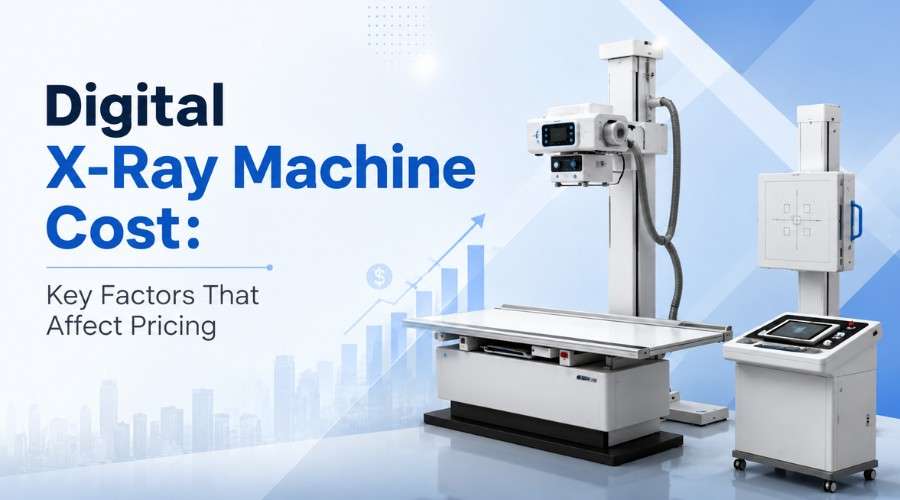
The global digital X-ray market was valued at USD 12.97 billion in 2024 and is projected to climb to USD 26.15 billion by 2033, growing at a CAGR of 8.1%. That kind of rise does not happen randomly. Industrial sectors worldwide are accelerating their adoption of non-destructive testing and quality inspection technologies, and digital X-ray machines is that inspection technology, which is incredibly versatile and is demanded by nearly every advanced industrial sector
But here is the procurement dilemma most buyers run into: you search for digital X-ray machine cost, and what comes back is a price range so wide it is essentially useless. One supplier quotes $8,000. Another quotes $180,000. Both are selling "industrial X-ray machines."
That price gap is important. And understanding what drives it is the difference between a smart capital equipment decision and an expensive sourcing mistake.
This guide breaks down every variable that affects digital X-ray system price range across all major machine types, so you can compare suppliers on qualitative aspects, not just sticker price.
The global industrial X-ray machine market is experiencing significant growth. That growth is driven by increasing demand across sectors like aerospace, automotive, electronics manufacturing, etc. Each of these industries has different output needs and compliance thresholds. That diversity alone explains a significant portion of the price variation.
The shifting technology trends, which include the accelerating shift from traditional film-based radiography towards digital radiography (DR) and computed tomography (CT) systems, are another reason for the pricing shift. Digital radiography machines offer faster results, higher resolution, and advanced analysis capabilities like 3D imaging. All these new features increase the capability of the machine, and the price moves with it.
Geography is another factor that affects the pricing. The rapid localization of production in the Asia Pacific, notably China, is creating significant price differentiation: high-end imported models retain premium pricing, while cost-effective domestic brands are making digital radiography accessible to more facilities. Chinese and Indian domestic brands offer systems 30 to 40% cheaper than imported alternatives.
That price advantage is real. But as you will see, it requires careful evaluation of what you are actually getting for the difference.
Not all digital X-ray machines serve the same function. Your industry inspection regulations, production environment, and productivity level will determine which machine variant fits your operation.
These are self-shielded, benchtop or floor-standing units designed for laboratory or quality control environments. These models are perfectly suited for inspecting electronics, battery cells, and small manufactured components. The enclosed design provides built-in radiation shielding. This makes them a practical choice for facilities that do not have the budget for building dedicated shielded rooms.
Average Price Range—$15,000 to $80,000
The price of this machine category is driven by specs like detector resolution, X-ray tube power output, and the user-friendliness of user software. Entry-level units cover basic 2D inspection. Higher-end cabinet systems offer additional features like CT capabilities for defect mapping.
Portable systems trade some inspection capability for field flexibility. They are battery-powered or plug-in units used for on-site weld inspection, pipeline testing, structural assessments, and field NDT operations. Entry-level portable or basic systems can start around $500 to $5,000; mid-range digital and specialized systems range from $5,000 to $35,000.
Average Price Range—$5,000 to $40,000
The spread here is wide because portable systems range from analog film-based units at the lower end to advanced DR systems with wireless flat panel detectors at the higher end. Ruggedization, battery life, and kV output (which determines material penetration depth) are the primary cost variables.
These are permanent installation systems built for high-volume, consistent throughput environments. They are used extensively in manufacturing quality control lines, foundry inspection, and heavy industrial applications. In China, entry-level fixed DR systems start at $35,000, and mid-range digital portable X-ray machine models cost $25,000 to $40,000, far below the prices of equivalent imported models.
Average Price Range—$35,000 to $120,000
Power output measured in kV, detector panel size, and the degree of automation in the positioning system all contribute to cost. Systems with motorized manipulators and programmable scan sequences sit at the higher end.
Inline systems are integrated directly into production lines and run continuous automated inspection without operator intervention. They are the standard in electronics manufacturing, SMT line inspection, food safety, and pharmaceutical production.
Average Price Range—$30,000 to $150,000
High-end industrial systems in the $35,000 to $90,000+ range encompass advanced food inspection systems, high-precision PCB inspection machines, and portable DR systems with 3D capabilities, with significantly enhanced performance, resolution, and software features. Throughput speed, conveyor integration, foreign object detection sensitivity, and AI-driven reject automation are the dominant cost drivers in this category.
Industrial CT systems are the variant that has the highest tier of inspection capability. It produces full 3D volumetric data. This allows for complete internal defect mapping, dimensional metrology, and complex assembly verification within one image. Undoubtedly, industrial CT scanners are priced considerably higher due to their advanced 3D imaging capabilities. Depending on the model, resolution, and features, prices typically range from $100,000 to well over $1 million. These systems are essential for detailed internal defect analysis, metrology, and complex assembly verification.
Typical Price Range—$100,000 to $1,000,000+
The microfocus X-ray source, detector panel resolution, rotation stage precision, and reconstruction software package determine where a system lands within that range.
Once you know which machine type you need, the next question is what pushes the price within that category. Here are the variables that matter most.
The initial cost of flat panel detectors (FPDs) is generally higher compared to traditional image intensifiers. They are also more delicate and require careful handling. In contrast, image intensifiers have a lower initial cost, but in the long term they need more maintenance and repairs due to degradation in performance. Flat panel detectors tend to provide better image quality and reflect the latest technological advances.
What really matters when procuring X-ray machines on a large-scale basis is total cost of ownership, not unit price. And in that respect, systems with a cheaper image intensifier today may cost more over a five-year asset life.
Measured in kilovoltage (kV), the X-ray tube's energy range determines what materials the X-ray machine can penetrate and at what thickness. Machines with a higher kV output will naturally have a higher manufacturing cost and be more expensive. A 160kV tube is standard for electronics inspection. A 450kV tube is required for thick-walled steel castings or aerospace components.
This is where the gap between basic and advanced systems becomes really noticeable. Entry-level machines have basic software that provides raw image capture and manual analysis. In contrast, advanced platforms are on another level. They come with software having advanced features that integrate AI-driven defect recognition, automated reporting, and network connectivity. These features add anywhere from $5,000 to $30,000 to the system price.
Manually operated systems require an operator to position, scan, and interpret results. Semi-automated systems offer programmable scan sequences. And the top-of-the-line fully automated inline systems run with zero operator input. Each step up the automation ladder adds cost. But on the positive side, that means more productivity and faster execution.
Systems that include built-in shielding (cabinet designs) eliminate the need for a dedicated shielded room to be constructed separately for the machine. This is a significant expense that can cost $20,000 to $50,000. That cost offset is worth factoring into your total budget.
Top-quality X-ray machine brands have a list of certifications that they must fulfill in order to be classified as top-grade. These certifications vary from industry to industry. For the medical sector, these include ISO 13485 for medical devices, CE, or FDA standards. For industrial sectors and aerospace and automotive sectors, adherence to NADCAP accreditation and specific OEM specifications is required. Certified systems carry a price premium, but they are non-negotiable for regulated industries. A system without valid certification documentation is a liability, not a bargain.
Standard catalog systems have the lowest price. The moment you ask for custom features like a custom conveyor width, a proprietary software interface, or a non-standard kV configuration, you move into OEM territory. Highly customized systems or OEM/ODM projects may require a minimum order of 3 to 5 units or more. But most manufacturers offer direct access to in-house R&D and often provide OEM/ODM capabilities that fit large-volume orders and custom projects.
You can get a quote for the same specification from three different vendors and receive three dramatically different numbers. This is because the vendor type matters, and the price quotes differ wildly according to whether you're purchasing from a factory, trader, or distributor.
Manufacturers offer direct access to in-house R&D and often provide customization services. They are the ultimate solution for a buyer who wants large-volume orders, custom projects, and technical collaboration.
Distributors offer a limited selection of standard models from multiple X-ray machine brands. Purchasing from them means faster delivery times, competitive pricing, and comprehensive regional after-sales support. For buyers seeking readily available inventory and better technical support, they are a great fit.
Traders, sitting between those two tiers, carry the highest pricing among all three vendor types. They often cannot provide batch-level documentation, factory audit access, or meaningful warranty support. This is because they do not own the manufacturing process.
A factory with a 5,000-square-meter production floor and dedicated assembly lines operates at a cost efficiency that a small workshop cannot match. Manufacturers with workshops larger than 6,000 square meters show 34% reorder rates versus 16% for smaller units. That reorder rate shows that the factory produces a superior quality product that has a strong reputation among buyers. Expect a higher price than a random trader in this caseA manufacturer with 10+ years in the industrial X-ray segment has a product with a successful design that performs on the field. It also has a network of supplier relationships for critical components. A newer entrant has not. High-performing manufacturers typically combine ratings of 4.8 or above, response times of three hours or less, and established operational histories. Such providers will naturally have a higher price quote than a trader that offers no such guarantees.
Before committing to any supplier, confirm the following details. These are the commercial and technical checkpoints that differentiate a sound procurement decision from one made without a plan.
MOQ Requirements
Lead Times
Warranty Terms
OEM and Customization Options
After-Sales Support and Spare Parts
If you are thinking that the digital X-ray machine cost conversation starts and ends with the quote, then that is the wrong mindset. For large-scale equipment procurement at this level, the quote is just the entry point.
Procurement teams should conduct total cost of ownership analyses that factor in maintenance, training, spare parts availability, and downtime risks and not just unit price before they commit to order placement.
Such diligence in procurement also favors the global picture where major market drivers include stringent quality control and safety regulations worldwide. These pressures are not easing. If anything, they are intensifying. The buyers who build reliable supplier relationships now, based on technical fit, compliance integrity, and total value, are the ones who will scale their inspection capabilities smoothly.
Summary It takes time, which
READ FULLYou are about to wire a significant sum of money to a company you ha
READ FULLA Chinese ultrasonic welding machine distributor may have more advantages than global ones. The r
READ FULL