




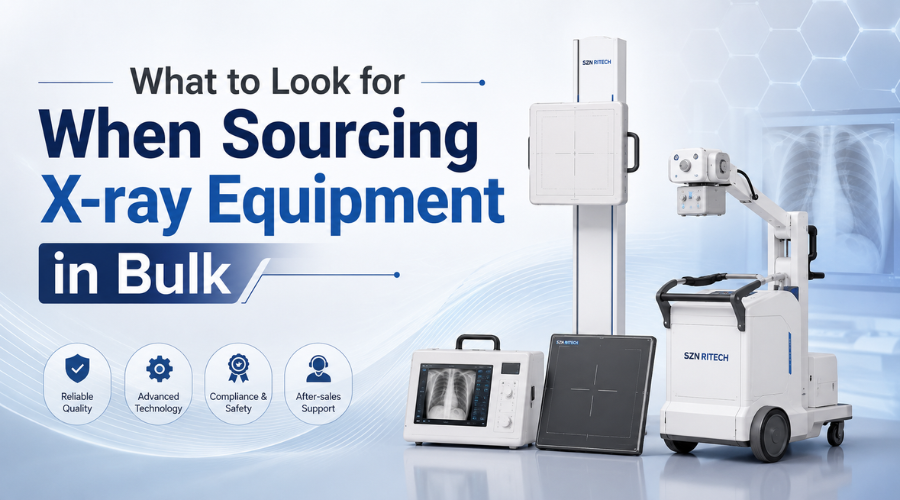
Bone fractures are common in the world, whether they occur in humans or animals. To diagnose those deep traumas in bones, doctors need digital X-ray machines. Every hospital needs them to meet global healthcare standards. Since there are different types of X-ray machines, a digital X-ray equipment supplier provides in-depth information. It is not about random selection of machines, because lots of factors are part of it. Procurement officers need to look at every factor before finalizing a compatible X-ray machine for the radiology department of their respective hospitals/clinics. Even distributors and retailers have to know about the types and secondary information for better selection.
It is a device that performs medical imaging in radiology. What it does is emit electromagnetic radiation, and this radiation creates an image at the receiving end. Hard objects like bones obstruct it, and the flesh allows it, resulting in a clear image of fractures and deformities. In detail, its emitter/X-ray generator releases high-speed electrons in large bundles. Then the detector receives them to show the results on a special polyester film. In modern machines, there are converters that transform those results into computer screens.
The healthcare sector procures these digital X-ray machines in bulk for radiology departments. Hospitals, clinics, laboratories, and veterinary hospitals are the largest consumers of X-ray machines.
• Medical and dental experts use them for the medical imaging process, where they detect flaws in bones mostly.
• Both humans and animals get fractures, traumas, and various injuries in bones, which is why these X-ray machines are essential equipment for that.
• Likewise, industries use them for flaw detection in hard and dense objects in quality inspections.
• Even security inspections require these machines for detection of unusual objects at airports, ports, etc.
There is not just a single X-ray machine that can perform all kinds of operations. You will find lots of types because patients require imaging from different angles and conditions. To meet specific conditions, there are different types in healthcare and a few other sectors.
The most common type of X-ray machine is a double-column floor-mounted type. It has a versatile solution for most kinds of radiology operations. From head to toe, it can image any area to detect fractures, deformities, etc. Its newer versions offer conversion of X-ray images into digital form on computer screens. Its bed and image generator’s adjustability provide a wide range of imaging solutions.
However, it occupies more space than the advanced types. Similarly, it has less flexibility than other types.
Then there is a suspended digital X-ray machine that has a different structure. Before you find its core difference, find out about its common features like the standard type. It also converts X-ray images into digital form on computers. It offers more flexibility than the standard type because of its overhead imaging system. Hospitals procure these suspended digital X-ray machines in bulk because of the following features.
• The X-ray tube (generator) is installed in the ceiling.
• It provides more space on the ground, especially in high-traffic diagnosis centers.
• Some versions have automatic movements of the ceiling X-ray generator for auto-positioning.
Then there is a more simplified version, which is a straight-arm X-ray machine. It is a wall-mounted type that saves more space. What it does is allow the doctor to do X-ray imaging vertically and horizontally more easily. The X-ray generator and detector are opposite to each other, but in the same arm. Patients simply stand or sit in the middle for the X-ray imaging.
It appears similar to the C-arm type, but there is a difference. The difference is in the angle, where the C-arm has an angular shape, while the straight arm has a linear shape. There is a motor inside to rotate that arm as per the imaging requirement. It takes just a static image where the patient has to be still.
Then comes the U-arm X-ray machine, which has a U-shaped arm. This arm has both an X-ray generator and a detector opposite each other for flexible X-ray imaging. It can take an image from head to toe for a more detailed solution. It is mounted on the floor as well as on the wall, which makes it flexible as per the diagnosis room’s layout.
Then comes a C-arm X-ray machine, which is suitable for fluoroscopy. It can take real-time images when the object/patient is moving. It usually has a movable arm or even a bed that rotates a patient into different angles for full diagnosis. It has features for both static and dynamic imaging depending on requirements. However, it takes more space since it is very bulky.
Then comes a kind of opposite of the previous type, which is lightweight and moveable. A mobile digital X-ray machine is like a C-arm X-ray machine with wheels. Hospitals procure it from a digital X-ray equipment supplier because of one main reason. Sometimes a patient can not be moved to a radiology room because of several reasons. So, doctors need to ask for the machine in the patient’s room. This is the use of a mobile X-ray machine. It can take X-ray images from different angles through its C-shaped arm.
Basically, it is a large-sized X-ray machine for non-medical use. What it does is inspect automobiles for security reasons for the detection of explosives and suspicious objects inside. Its structure is different from a standard X-ray machine. Its X-ray generator and detector are wide apart from each other, and automobiles have to pass through them. It can image a real-time moving vehicle for the detection process.
A similar version is at airports and ports for the inspection of goods inside the luggage. These machines have been in the industry for decades. They provide a clear and real-time image of moving luggage for detection of suspicious items inside.
Veterinary hospitals also have X-ray machines with a slight difference in structure. Some machines have small beds for pets and similar small-sized animals. While some machines have a large structure with overhead installation of X-ray generators. Similar to double-column floor-mounted X-ray machines, they provide a simple imaging solution. With a small bed size, doctors can examine fractures and traumas in pets quite conveniently. The healthcare sector needs digital X-ray machines in bulk because of these essential needs. Veterinary clinics use suspended X-ray machines for farm animals like cattle, horses, etc. There is a frame in this type, which keeps the animals still during the imaging process.
Then the last type is a dental X-ray machine. It is a low-frequency and portable machine because it has to capture only the mouth region. Doctors place a digital sensor film inside the patient’s mouth to detect flaws or teeth structure on a small film. An even more portable version is available, which is a handheld device.
Buyers who are either buying a single unit or digital X-ray machines in bulk. Hospitals, clinics, distributors, and retailers have to look at various elements during the procurement process. What are the key elements buyers have to look at when selecting X-ray machines?
The first thing is the need, which makes buyers select the type of X-ray machine. Is it for humans, animals, or non-living objects? There are different types of X-ray machines, and the primary selection factor is based on it. Then comes the room’s layout where you will place the machine. The layout and space inside the radiology room will decide whether you need a ceiling-mounted, floor-mounted, wall-mounted, or mobile X-ray machine.
If it is for high-traffic areas, it is better to go with a ceiling X-ray machine. It will give you more space on the ground for movement.
Choose an X-ray machine whose acquisition software is compatible with PACS (Picture Archiving and Communication Systems). There are various types of software, and you need to consult with your bioengineering team mostly. It includes the power compatibility and the voltage range followed in your region.
In this modern age, the most advanced X-ray machines are in demand. Doctors need machines that can capture an image within 10 or 5 seconds. Digital radiography and fluoroscopy are the most common types in the present healthcare sector. So, you will have to choose between these two types for fast image processing.
The maintenance and operating conditions have to be convenient. If your professionals face difficulty in operating and maintenance activities, there will be lots of challenges for you. Choose X-ray machines that are easy to learn, operate, and maintain. The downtime must be very little, which depends on the maintenance difficulty level.
Are you purchasing new or refurbished X-ray machines? The price varies based on many factors, and it is one of them. It could be any type, but what you need to do is select a reliable and affordable supplier. The supplier selection will take lots of time. Go through B2B platforms like Alibaba.com, Made-in-China.com, Tradewheel.com, etc. You will find many suppliers, especially Chinese ones with competitive prices and world-class quality. One of them is Suzhou New Rising Intelligent Technology Co., Ltd. You can find such suppliers with reasonable ownership costs, which cover price, shipping, and every other cost. Make sure you ask for a warranty that is long enough to meet your requirements.
CE, IEC 60601-1, IEC 60601-1-3, FDA, ISO 13485, and some other certifications are mandatory. You need to ask the supplier for these certifications for global safety compliance. These compliances will ensure that the digital X-ray machines in bulk you need are safe and compatible. There are also other documents you need to look at, which are a business license, export certificate, etc.
There are different types of X-ray detectors, and each has a different compatibility. The working conditions, applications, and type of X-ray machines will help you decide. You will have to ask the supplier for the documents regarding the detector type in the specifications for compatibility level. Scintillation detectors, FPD (Flat Panel Detectors), CCD (Charged Coupled Device), and CR systems are some examples.
When installing these X-ray machines in the radiology rooms, safety precautions are mandatory.
• Thyroid collars
• Lead aprons
• Lead wall
• Operational time
• Distance between operator and the machine
These are the factors that need to be kept in mind. Thyroid collars, lead aprons, and lead walls are the primary protective shields for doctors. Frequent use of X-ray machines is surely harmful for professionals because of dangerous exposure to X-rays.
The final words will be about the selection of X-ray machines. Choose the type and size depending on the application and room layout. Humans, animals, and non-living objects require different types of X-ray machines. They work in the same way, but their features and compatibility levels are different. So, you need to select them based on your requirements and choose a certified supplier who can offer fair prices.
Who Could Supply X-ray Equipment of Different Types at a Fair Price?
Suzhou New Rising Intelligent Technology Co., Ltd. is one of the affordable digital X-ray equipment suppliers. You can find U-arm, C-arm, straight-arm, suspended, and double-column floor-mounted X-ray machines in its collection.
Can a Single Supplier Have Different X-ray Machines for Different Sectors?
Yes, a single supplier can have different X-ray machines for different sectors. One such supplier is Suzhou New Rising Intelligent Technology Co., Ltd. It has U-arm, C-arm, straight-arm, suspended, double-column, floor-mounted, and pet X-ray machines.
Do Veterinarian Doctors Need Different X-ray Machines Than Usual Ones?
Yes, they need a different type of X-ray machine. These are pet X-ray machines that are slightly similar to a double-column floor-mounted machine, but the bed’s size is small. Also, they use suspended X-ray machines for X-ray imaging of cattle, horses, etc.
Summary It takes time, which
READ FULLYou are about to wire a significant sum of money to a company you ha
READ FULLA Chinese ultrasonic welding machine distributor may have more advantages than global ones. The r
READ FULL