



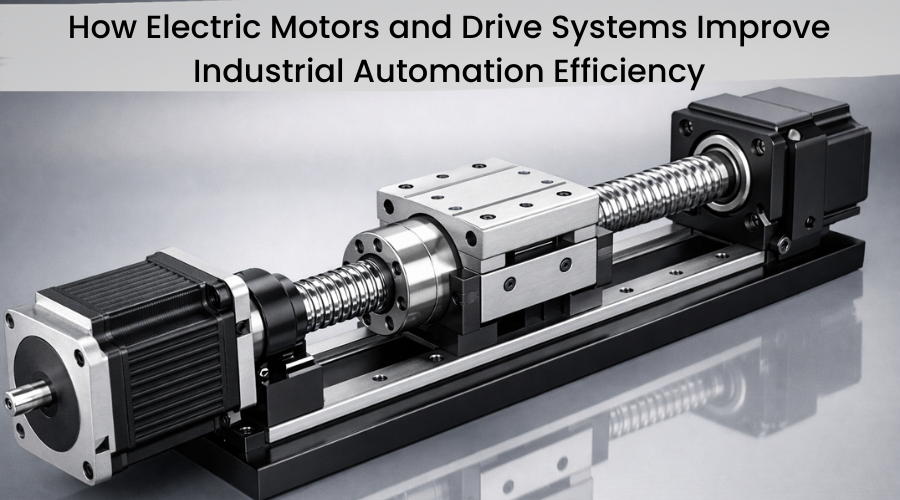
Industries are frequently upgrading themselves to speed up production output. That includes ultra-speed movements of robotic arms, energy savings, and consistent performance. That also includes less maintenance. How do all these things come together? The answer is a ball screw linear driver, which provides an ultra-fast repetitive performance. It is a type of electric motor that runs on an advanced drive system.
These components make robots more efficient than traditional industrial machines. As a result, industries achieve their advanced targets better than before. It also includes the integration of these motors with machines like conveyor belts, sorting machines, and the list goes on. These machines operate well when the drive systems are more competitive. To make things easier, here is how electric motors and drive systems improve automation efficiency.
The entire industrial automation relies on some essential machines for stable performance. They are different from traditional machines in terms of motors, drive systems, supportive components, etc. Drive systems improve the automation by regulating the current of AC motors. In this way, the voltage is always balanced for the safety and regulated performance of motors. These AC motors are inside almost every industrial machinery for angular or linear motion.
To aim for this performance, every industrial user needs an electric motor and drive manufacturer. There are many manufacturers who design electric motors and drive systems to meet the special needs of companies. These needs are all about the compatible performance and efficiency at a low cost.
A VFD system is one of those systems that controls the motors inside the machines. VFD controls the motor’s speed depending on the demand of the system. It regulates the speed and torque based on the system’s requirements. It saves energy by maintaining the operating power efficiently. This mega feature leads to cost-effective operations in industrial automation.
Besides the energy saving, it also stabilizes the motors to extend their lifespans. Conveyor belts, production robots, water pumps, and many machines need voltage regulation. If there is no voltage stability, the coils in the motors and other sensitive components will be at risk of damage. Therefore, VFD provides soft start and also hard start as per the requirements of the system.
The electric motors inside need guidance for optimum performance. They can only do the basic operations unless a drive system is connected to them. That drive system is unique to each motor, and it guides it to work according to the mechanism a machine needs. For instance, some machines require high-speed movement with back-to-back changes in direction. To run those machines, a drive system plays a central role. It controls the speed, direction, and voltage of the motors inside it. As a result, there is a precise speed change without any risk of fluctuation. When choosing an electric motor and drive manufacturer, industrial users have to look at the operating conditions.
Without a drive system, any industrial machine cannot operate efficiently. The entire stability and torque of that machine’s motor depend on the drive system’s performance.
Unlike old motors in traditional industrial machines, the newer ones have different performance. Older ones had a problem of hard start, which used to make a hard impact on motors. Those motors did not have any sophisticated drive system that could provide a soft start. Therefore, the risk of coil damage and similar hardware problems was frequent in the machine. Overheating, voltage issues, and various problems used to damage industrial machines in the past.
However, drive systems and modern motors increase the lifespan of the machine. They prevent the hard start, which is a very common cause of motor damage. By providing a stable start, drive systems keep the motors in good form along with their components. It does not mean that these systems cannot generate high torque when needed; they can also provide instant torque for machines that need a hard start. So, industries get both kinds of support from drive systems when starting different kinds of motors.
Electric and hybrid vehicles and some industrial machines also use this system. It is a system that does not let the energy go in vain, and uses it for other applications. Regenerative braking provides an energy-saving mode. It is a system that converts kinetic energy during the braking process and converts it into electrical energy. In EVs, this system uses the energy from the brakes to charge the battery. A drive system provides key support in this energy recycling process. Automobiles in modern times will rely on this feature the most.
Linear motors are one of the types of electric motors that provide lean, agile, and efficient support. These motors convert electrical energy into linear motion. The rotor moves in a linear position on a track made of the stator. The entire movement takes place on a magnetic track that prevents every kind of physical contact between these two components in a motor. An electric motor and drive manufacturer knows how these linear motors contribute to automated functions in industries.
Many industrial machines in a warehouse have to be fast enough to do operations at ultra-high speed. These machines are good at providing instant acceleration since there is no friction inside their motors. They contain the same linear motors that run on magnetic tracks. Due to having zero friction, these motors generate super speed in their operations. These operations take place in production plants where fast-speed production, packaging, and testing processes take place.
There is no physical contact between the rotors and stators inside the linear motors. The entire structure is based on magnetic force. Due to this reason. There is no need for maintenance for a long time in these motors. Moreover, there is no risk of wear and tear in the stators and rotors. The speed is ultra-high, and there is no such wear and tear inside the motors. That makes linear motors an ideal choice for automatic operations in factories. Industries can continue the operations for long hours without any fear of overheating in the motors.
Since there is no physical contact between the rotor and stator, there is no need for greasing. Unlike traditional machines and their overheating problems, these machines have different methods. The movement is mostly based on a magnetic system, which does not need any greasing. Wear and tear are very low, and much lower than traditional ones.
So, there is no need for greasing in the linear motors, and industries find it a cost-effective choice. There is no risk of contamination either. That makes lots of difference in the industrial cost of operations. In the modern era, most industries are switching to automation, and linear motors are among the ideal choices for them.
Here is another relief for the automation industries. There is no need for belt or chain replacement in linear motors. They operate differently from traditional machines, which used to contain rotary motors with belts. The cost of belt damage and its repairs is a challenge for industries that use them. There is no reliable replacement until one uses linear motors. Linear motors give relief from grease, belt, and various components’ replacement in maintenance.
The maglev system, or magnetic levitation system, is a central body in super-speedy operations in the automation industry. The production of various components relies on magnetic levitation. It is common in the semiconductor industry. The rotor moves on a stator in a linear position. That is a straight-line movement, which has no physical contact.
Many robotic arms and similar machines use linear motors for high-speed magnetic force. As a result, the speed of operations increases by a huge margin. His maglev system makes automation fast and consistent for mega operations and high efficiency.
Again, there is not much sound in the linear electric motors since they have a maglev system. There is no need for gears or any physical contact, which could make sound in the operations. Industrial machines work quietly compared to the traditional ones. One of the examples is electric vehicles. Some EVs use components that have linear motors for stable support. However, EVs still rely on rotary motors, and one can deny the success of the rotary types. Still, linear motors are making their way to more agile and efficient movements at quiet mode.
Industrial production and packaging processes rely on robots in many companies. The reason is clear, and it is high precision, consistent repetition, and quiet operations. Linear electric motors and their drive systems are the primary support for robotic arms. Ball screw linear drivers are good at maintaining repetitive performance in those robots. Robotic arms are good at production and also packaging when it comes to large-scale operations. Therefore, industries have to rely on them by installing linear motors in them. The drive system ensures stable voltage and movement; the rest is done by the motors.
Pick-and-place operations need repetition, and linear electric motors are good at it. Another main component that supports these operations is a ball screw linear driver. It generates the torque in frequent movements of robotic arms without any risk of overheating. Since there is no physical contact between the rotors and stators, one can expect the robots to perform efficiently without any risk of damage. However, traditional motors have mechanical operations inside, which may get overheated. That is what makes linear motors better in robotic arms than other options.
Then the last application of linear electric motors and their drive systems comes. This is about ultra-fast packaging and sorting that is the utmost need of industries. Robotic arms perform this job frequently without any risk of internal damage. They pick and place products frequently in packaging and sorting operations. The drive system helps them perform this action, and the motor complies with its requirements.
Industrial automation is all about precision and lean operations. That is possible when the robots perform the operations at high speed with consistency. They can do that only when there are some components present inside them. Those components are electric motors and drive systems. These electric motors have a type, which is a linear motor. These motors operate on a magnetic levitation system. That means there is no physical contact between the rotor and the stator in the power generation. Hence, there will be no need for belts, chains, or any supportive component to run the motor. Besides, there is no need for frequent maintenance and any risk of wear and tear. Industries use these motors to perform quiet, repetitive, and efficient operations at low cost.
Industries are frequently upgrading themselves to speed up productio
READ FULLE-commerce is all about faster ordering, processing, and delivery. The way a website or applicati
READ FULLChoosing the appropriate stainless storage tank supplier is critical
READ FULL