




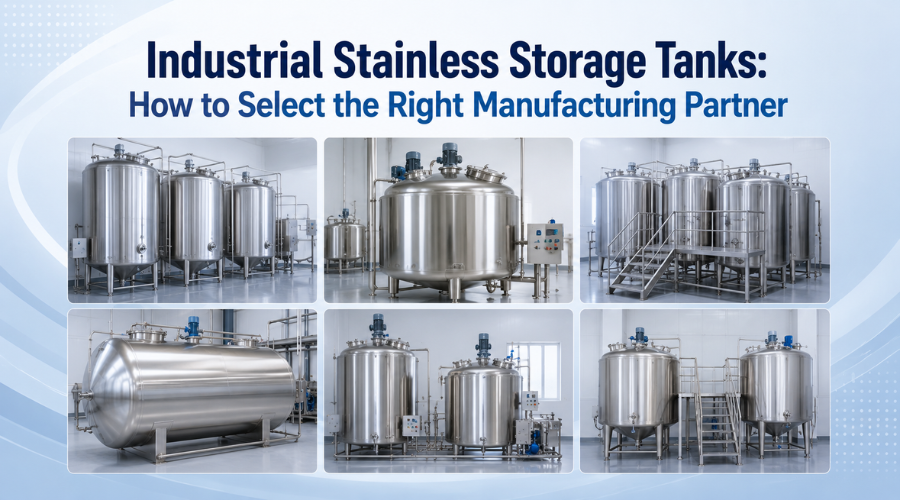
Sourcing industrial equipment at scale is a complex process. And being in the industry, you would already know that. When it comes to bulk stainless storage tank distributor partnerships, the margin for error is even smaller. A wrong call on a manufacturing partner does not just cost you money on a single order. It can bring a production line to a halt, trigger compliance failures, or create safety liabilities that take months to untangle.
The global stainless steel tank market was valued at $12.5 billion in 2024 and is projected to reach $18.7 billion by 2033, growing at a CAGR of 4.5%. That kind of growth signals one thing clearly: that demand is accelerating, and so is the number of manufacturers competing for your procurement budget. This naturally means more options for you to choose from, which may look favorable generally. But in practice, it means the qualification process needs to be more careful and diligent so that low-grade manufacturers are weeded out.
This guide gives you a structured, expert-backed framework for evaluating and selecting the right stainless steel storage tank manufacturer for your operation. The framework we will give you will be quite adaptable and will help in your procurement efforts no matter which industry you are in, whether pharmaceuticals, food and beverage, fine chemicals, semiconductors, or new energy.
The industrial chemical stainless steel storage tanks market is growing steadily, driven by increasing demand for durable and corrosion-resistant storage solutions across chemicals, pharmaceuticals, and food and beverage sectors. That demand growth has attracted a wide range of suppliers, not all of whom have the engineering depth or quality controls to meet the operational demands of regulated industries.
Procurement managers and plant engineers who skip thorough vendor qualification often discover the consequences at the worst possible time. Some of the disasters that happen are weld failures under pressure and surface contamination in a pharmaceutical batch. But perhaps the thing that causes loss of reputation the most is delayed delivery. Because the factory could not scale to the required volume. In 2024, over 41% of tank manufacturers reported delays due to certification bottlenecks, especially in cross-border projects, with design reworks and additional costs averaging $13,000 per project.
The stakes are real. The solution is a planned approach to partner evaluation before you sign anything.
The most common sourcing mistake is approaching manufacturers before you have a clear internal brief. If your requirements are vague, you will get vague proposals.
Before contacting any stainless steel storage tank manufacturer, work through the following questions internally:
The chemical and physical properties of what you are storing will determine material grade, lining requirements, and pressure ratings. Reactive chemicals behave very differently from food-grade liquids or pharmaceutical intermediates.
The 5,000 to 50,000 liter range is the most purchased sub-segment, holding around 42% of the market share in 2024. This capacity offers a balanced combination of storage volume and operational flexibility. That makes it suitable for mid- to large-scale processing facilities.
Grade 304 suits general-purpose food and chemical storage. For maximum protection against corrosion, Grade 316L is a good fit, especially for chloride-heavy environments and pharmaceutical-grade applications. For high-temperature applications, Grade 310S is the best option. Matching the grade to the application is the only way to ensure success.
Industrial storage tanks are not like ordinary containers. They are meant to be integrated into a factory setup and come with several add-on features. These can be heating jackets, refrigeration systems, stirring mechanisms, measurement devices, mirror-polish finishes, Teflon lining, and many more. Adding these features means more customization. Know your process requirements before you enter any negotiation.
Your industry, your geography, and your end product each carry specific regulatory obligations. Identify them early. A manufacturer who cannot meet your compliance baseline is simply not qualified, even if he offers an attractively low price.
You need documented proof that the material used in your tank matches what was specified in the contract. The way you confirm that is through Mill Test Certificates (MTCs) from the steel producer. Every order should have one. Do not accept manufacturer-generated documentation as a substitute.
Use a handheld XRF analyzer, or request a third-party lab test, to confirm that the stainless steel grade, such as 316L, matches the promised specification. Cases of getting the wrong steel grade is a relatively common occurrence, and visually, both look identical. So getting scammed is really possible.
Weld quality is what separates average manufacturers from expert ones. Storage tanks used in industrial setups must fulfill pressure-bearing or hygienic standards. These include matching ASME Section IX or AWS D1.1, depending on the application.
A common sourcing error made by procurement professionals is failing to clearly define the "surface finish" and "weld standard" in the contract. A vague requirement for a "high-quality finish" often leads to misunderstanding, and you get a wrong product that does not perform well during operations. To avoid this, you need to outline the surface finish parameters such as Ra values and specify your weld standard by name in every purchase order.
Certifications are not just paperwork. They are proof that the manufacturer is committed to maintaining quality through following manufacturing protocols and internationally recognized engineering standards.
For most industries, the ISO 9001 for quality management is the basic requirement. Market-specific requirements include CE marking for European markets. Then there are industry-specific certifications like ASME certification for pressure vessel applications and GMP compliance for pharmaceutical or food-grade production. To minimize supply chain risk, request the business license, export rights, and specific certifications relevant to your product destination. A certificate on a website is not enough. Your vetting process should consist of requesting originals and verification with issuing bodies.
Tanks of standard sizes rarely fit complex industrial setups without modification. So, a capable manufacturing partner needs to have the manufacturing expertise to produce tailor-made sizes and configurations. This also includes additional features that the tank might require like non-standard nozzle placements, thermal jacketing, insulation systems, and instrumentation integration.
Your job is to confirm if the manufacturer is flexible enough to adjust the tank design for integration into a specific factory setup. Ask for drawings or project portfolios from comparable past work. A manufacturer who has successfully built tanks for your industry application is a fundamentally lower-risk partner than one who claims they can figure it out.
A manufacturer may deliver your pilot order beautifully but struggle to meet the order size. This kind of problem happens with manufacturers who have limited production capacity. To avoid this from happening, you must ask about the current order backlog, production floor size, headcount, and the number of production bases they operate before you seal the deal.
China is the undisputed market leader in terms of scalability, and suppliers in Jiangsu and Zhejiang provinces are known for precision engineering and a strong export focus, with many excelling in high-quality, customized tanks for demanding sectors like pharmaceuticals, food and beverage, and electronics.
A tank is a long-term asset for any factory and has a long service life. And during that service life, malfunction is guaranteed to happen. Your relationship with the manufacturer should be strong enough to resolve these kinds of post-delivery issues. And for that, the level of after-sales service and technical support you get becomes really crucial. Before signing the contract with the manufacturer, confirm if the manufacturer provides such support or not.
The best way to go about it is to ask for references. Contact existing clients, especially those in your region or industry. A manufacturer who actively facilitates reference conversations is one who is confident in their own track record.
You will encounter suppliers who look credible on paper but fall short under scrutiny. Here is what to watch for.
Vague surface finish or weld standard specifications in quotations. If a quote does not specify a named weld standard and a measurable surface finish value, the supplier has not done the technical work required to build to your specification.
Any qualified bulk stainless storage tank distributor or manufacturer should provide MTCs without hesitation. Reluctance to support third-party inspection is a significant warning sign. Engage a third-party firm like SGS, BV, or TUV to conduct an independent inspection of their facilities and the physical quality of the finished tanks before shipment.
You should provide site-specific design load requirements, including wind, seismic, and internal pressure specifications, early in the bidding process. If a manufacturer cannot accommodate these parameters, they are likely not suited for high-risk industrial projects.
Relying on one manufacturing partner without any backup supply plan creates vulnerability. Understand the manufacturer's own supply chain for raw materials and how they manage disruptions.
Slow or evasive communication. If a supplier takes days to respond during the pre-sales phase, do not expect it to improve once you have placed an order.
Selecting a stainless steel storage tank manufacturer is a decision that will affect your operation for years. The tank itself has a service life measured in decades. The partnership built around it should be held to the same standard.
Prioritize fabricators who demonstrate long-term export success and a clear understanding of your specific industrial application, whether it is high-purity pharma or large-scale industrial chemical storage.
The six criteria covered in this guide—material traceability, weld quality, certifications, customization capability, production scalability, and after-sales support—give you a consistent, defensible basis for evaluation. Apply them to every shortlisted supplier. Score them. Compare them.
Stainless steel tanks are essential in various industries due to their durability, corrosion resistance, and ability to maintain the purity of stored substances. A tank that fails to perform on any of those dimensions is a liability, not an asset. And the manufacturer who built it without the right qualification process in place is a partner who was never truly qualified to begin with.
Take the time to do this properly. Your production continuity, your compliance record, and your bottom line depend on it.
How do I know if a builder uses quality steel?
Ask for Material Test Reports (MTRs). These papers track the steel back to the mill. It guarantees you get the grade of stainless you paid for.
Can a manufacturer help with the design?
Yes, the best shops have in-house engineers. They can suggest the best wall thickness and nozzle placements. This saves you from costly mistakes later.
What is a fair lead time for a custom tank?
Most custom builds take 8 to 16 weeks. It depends on the size and current shop load. Always get a firm date in the contract.
Summary It takes time, which
READ FULLYou are about to wire a significant sum of money to a company you ha
READ FULLA Chinese ultrasonic welding machine distributor may have more advantages than global ones. The r
READ FULL